1 Basic concepts and testing methods
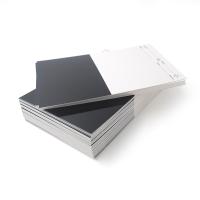
Hiding power refers to the ability of the coating film to cover the base color of the painted surface after the paint, ink, etc. are coated. The hiding power is the result of the scattering and absorption of light by the pigment. Then the hiding power of architectural coatings, as the name suggests, refers to the ability of architectural coatings to no longer show the background color applied to the surface of objects today. Generally, the minimum amount of coating per unit area required to cover the black and white grid on the glass plate is used (ie g/mZ) to represent.
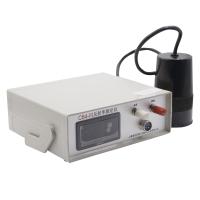
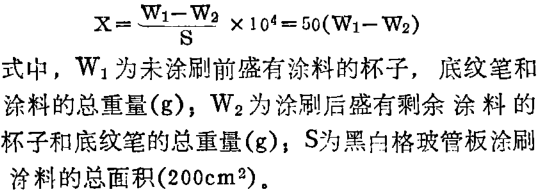
The method of measuring the hiding power is mainly based on the quantity specified in the product standard, and the total weight of the cup containing the paint and the shading pen is weighed on a balance with a sensitivity of 0.01g. Use a shading pen to evenly brush the paint on the black and white grid glass plate, 15~20cm away from the frosted glass sheet. One end with black and white grids forms an angle of 3c~45° with the flat and inclined. Observation under 1 and 2 Ge fluorescent lamps, the black and white grid is just invisible as the end point. After that, weigh the cup and shading pen containing the remaining paint again, and find out the paint weight and hiding power on the black and white grid glass plate g/m" (again) calculated by the following formula
2. The practical significance of hiding power
In the actual sense, hiding power is a very important coating performance. First, wall decoration coatings with decorative functions. It needs to be able to cover the substrate well without showing the substrate. But in fact, there are indeed many disputes between users and manufacturers because of the hiding power of the products. Secondly, it is difficult to cover the old wall surface due to pollution due to smearing or other reasons, and the construction of architectural coatings is generally two layers, so it is necessary to require the coating to have good covering power. Third, architectural coatings are mostly white or light-colored, Due to the limited selection range or cost of pigments and fillers, it is much more difficult to improve the hiding power than dark paints, that is, there are certain technical difficulties.
3. Measures to improve hiding power
Like ordinary paints and coatings, the main factors affecting the hiding power of architectural coatings are pigments, fillers and their dosage (or pigment volume concentration), the grinding fineness of pigments and fillers, and the viscosity of paints. To improve the hiding power of architectural coatings should be based on Take corresponding measures based on its influencing factors, such as correct selection of pigments and fillers, improving the grinding fineness of pigments and fillers, and increasing the amount of fillers.
3.1 Correct use of pigments and fillers
The main factor that determines the hiding power of the paint is the difference between the refractive index of the pigment and the base material. When the two are equal, the pigment is transparent and does not have a covering effect; when the refractive index of the pigment is greater than the refractive index of the base material, the pigment has covering ability. . The greater the difference between the two, the stronger the hiding power of the pigment. Since the refractive index of the paint base material is constant, the higher the refractive index of the pigment, the greater the hiding power it will bring to the Xu film. Table 1 lists the refractive index of commonly used white pigments and fillers. However, the general refractive index High-efficiency white pigments are very expensive.
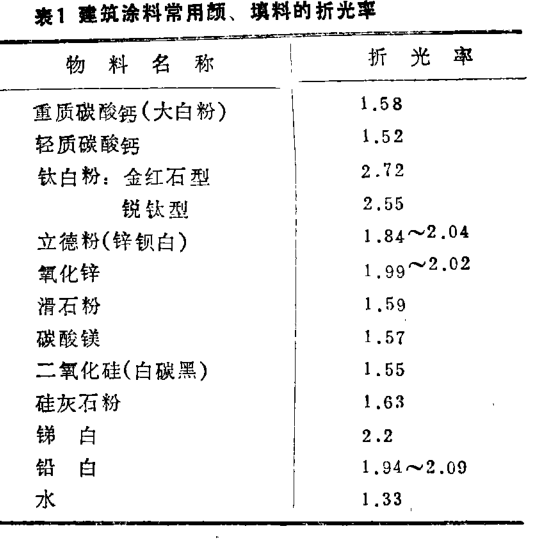
1 shows that among all kinds of white pigments, the refractive index of Chin white powder is the largest, followed by Lithopone. It can be seen that to improve the hiding power of architectural coatings, Chin white powder or Lithopone should be selected. For example, high-grade styrene-acrylic latex paint generally only uses Chin white powder (rutile type or sharp Qin type can be), so that its PVCC pigment volume concentration) as low as possible.
3.2 Increase the color and filler of the paint
Dosage Ordinary paints should choose some pigments or fillers with low refractive index, such as talcum powder, wollastonite powder, etc. For example, ordinary interior wall paints have rarely used high-refractive index pigments such as Chin white powder or Lithopone, etc. , while fillers such as light calcium carbonate, talc powder, wollastonite powder and heavy calcium carbonate are mainly used. According to the author's experience, as long as the total mass percentage of the above-mentioned several fillers is guaranteed to be between 30 and 35, the covering power can generally meet the requirements.
3.3 Guarantee high grinding fineness of pigments and fillers
Under the same pigment and filler type and the same amount, the higher the grinding fineness, the greater the hiding power. Therefore, ensuring that the pigment and filler in the paint have a higher grinding fineness can also improve the hiding power. Improve the fineness of the paint When the temperature is high, appropriate technological measures can be taken to improve its dispersion and grinding efficiency, and wetting agents and dispersants can also be used appropriately to make the pigment and filler particles fully wet and easy to depolymerize.
4. Summary
The above are some introductions about improving the hiding power of architectural coatings. In order to enhance the hiding power of architectural coatings, construction personnel need to correctly use pigments and fillers in daily operations, increase the pigments and fillers of coatings, and ensure that the pigments and fillers are relatively high. High grinding fineness. This increases the hiding power of high architectural paints.
This article mainly excerpts from Xu Feng's "How to Improve the Hiding Power of Architectural Coatings"