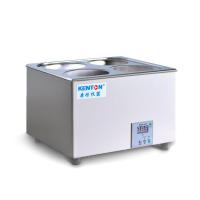
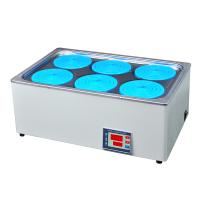
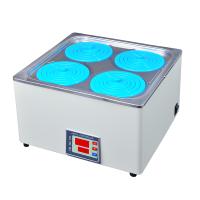
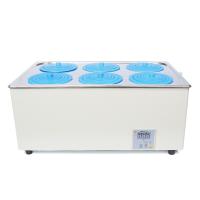
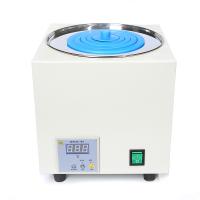
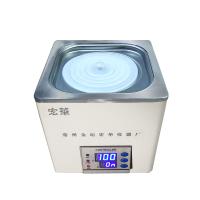
In thermal experiments, it is often necessary to measure the relationship between a certain thermal physical quantity G and temperature T. G = G( T). In order to do a good thermal experiment, there must be a good heating device, which can effectively control the temperature, and can be heated quickly. To achieve thermal equilibrium , and maintain thermal equilibrium for a period of time, in order to accurately measure G and T. The constant temperature equipment Water Bath commonly used in chemical experiments has a temperature setting device. When it reaches the set temperature point, it will automatically stop heating and enter Constant temperature state. There are two types of Water Baths: single-slot Water Bath and double-slot Water Bath, which can be selected according to needs. We choose the single-slot Water Bath for the measurement experiment of the temperature coefficient of resistance, and the double-slot Water Bath for the thermocouple error Experiments for the determination of electrical coefficients .
Remove the cover of the single-slot Water Bath, take a piece of plexiglass , cut it into a cover according to the size, install eight binding posts on it, and connect two four-terminal resistors, on a 1/2 W 100 kΨ carbon film resistor Wind 150 turns evenly with 0.29mm enameled wire, and the lead wire is welded on the resistor . The resistance value of this resistor is about 3Ψ at room temperature. Open a small hole in the plexiglass and make a small bracket for fixing the thermometer. The two resistors and the thermometer bulbs are basically on the same level. The plexiglass cover is put on, and the resistors and the thermometer bulbs are immersed in the water in the pot. This device can be used by two students to measure the resistance temperature coefficient of copper at the same time. Four terminals The resistance value of the resistor can be measured with a two-armed bridge.
There are special requirements for the double-slot Water Bath. The heat insulation between the two tanks must be achieved, and the temperature of the first tank can also be displayed by a digital thermometer. The double-slot Water Bath is also covered with plexiglass, and students can see what Drill holes in the cover and make two sets of copper-constantan thermocouples. The temperature t 2 is displayed by a digital meter for the heating tank, and t 1 is measured by an ordinary thermometer for the cold Water Tank. The temperature difference is Δt = t 2 - t 1 Potential potentiometer measurement. This setup can also be used by two students to experiment simultaneously.
Do thermal experiments with a Water Bath, measure a point every time it rises 8-10°C, students set the temperature point in advance, it will be automatically heated after setting, there is a red light indicator, and it will turn into a green light when it reaches the set point. Due to thermal inertia, it is required Students measure the data one minute after the green light is on . Generally, the experiment ends at the 90°C measuring point. Doing thermal experiments with a Water Bath can not only effectively control the temperature and achieve a relatively stable thermal balance, but also effectively solve the safety problem. The pot shell is used The three-wire plug is effectively grounded to eliminate the risk of electric shock. In the past, the power , and the wiring will never happen again.