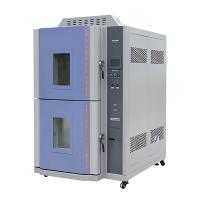
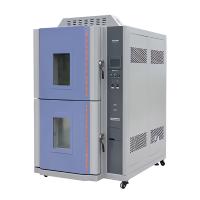
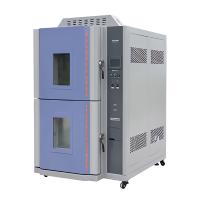
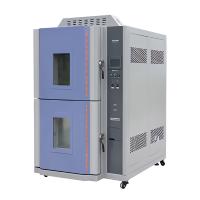
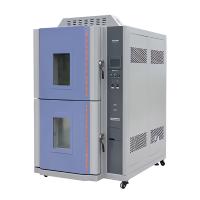
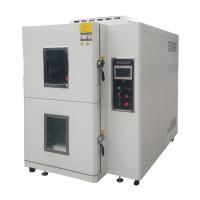
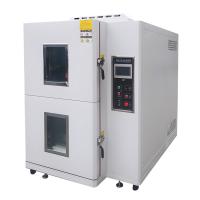
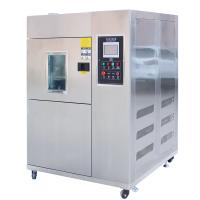
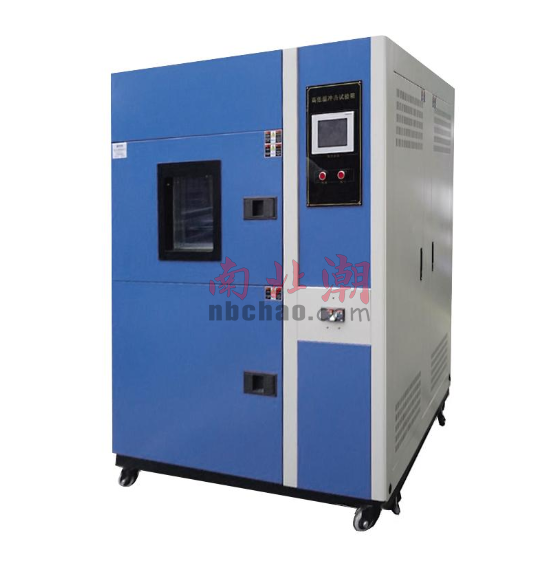
The thermal shock testing machine is mainly used to simulate sudden changes in high temperature environment and low temperature environment, and to test the performance stability of items under the physical and chemical changes caused by thermal expansion and contraction. Today I mainly share how the cold and heat shock test machine can detect leaks and discharge sewage of refrigeration units?
The principle is to simulate changes in hot and cold environments in a short period of time, in order to reflect the performance changes of the test items in the natural temperature changes more quickly. Widely used in industries such as batteries, metals, plastics, rubber, electronics, and electrical engineering, ranging from aerospace component materials to automotive engines.
1. Connect the decompression valve to the nitrogen cylinder, and connect the decompression valve of the nitrogen cylinder to the ammonia addition valve of the system with a nitrogen pipe;
2. Open all valves in the system except the valves connected to the atmosphere;
3. Open the ammonia valve and nitrogen valve, and fill the system with nitrogen to the test pressure of the low pressure part;
4. Close the ammonia valve and nitrogen valve, use a brush dipped in soapy water or detergent to smear all welding joints, pipe joints, flanges, valves and other connection and sealing parts for leak detection;
5. Find out the leak point and mark it. After finding out a batch of leak points, the operator in the temperature shock Test Chamber shall be in a safe position for sewage discharge operation and unscrew the screw plug at the lower part of the low-pressure circulating liquid reservoir (or gas-liquid separator) , blowdown and release nitrogen;
6. To repair leaks, screw on the screw plug of the low-pressure circulating liquid receiver (or gas-liquid separator), refill nitrogen, and the operator is located in a safe position for sewage discharge operation, unscrew the screw plug at the lower part of the intercooler, discharge sewage and release nitrogen;
7. Repeat the previous two steps until there are no leaks;
8. Close the liquid inlet valve and oil drain valve of the low-pressure circulating liquid receiver (or gas-liquid separator), close the liquid discharge barrel outlet valve and oil drain valve, the compressor suction valve and oil drain valve, and fill the system with nitrogen to High pressure part test pressure;
9. In the leak detection of the high-pressure part of the temperature shock Test Chamber, find out the leak point, mark it, and find out a batch of leak points, the operator is located in the safe position of the sewage discharge operation and unscrews the screw plug at the lower part of the liquid discharge barrel to discharge the sewage and release it. nitrogen;
10. Repair the leak, screw on the screw plug of the liquid discharge barrel, and refill the nitrogen gas. The operator of the temperature shock Test Chamber is located in a safe position for the sewage discharge operation and unscrews the screw plug at the lower part of the high-pressure liquid receiver to discharge the sewage and release the nitrogen gas;
11. Repeat the previous two steps until there is no leak point.
After using the thermal shock Tester, be sure to wait for the temperature in the box to return to normal before cleaning the test object to avoid being burned by high temperature. Due to the sudden change of high temperature and low temperature, particles often condense, so it is necessary to clean the air outlet frequently to avoid blockage caused by particles. After not using the thermal shock testing machine, remember to cut off the power supply in time.