The four words of haze, transmittance, refraction, and gloss are easily confused, so what is the difference and the same between these four before?
Haze
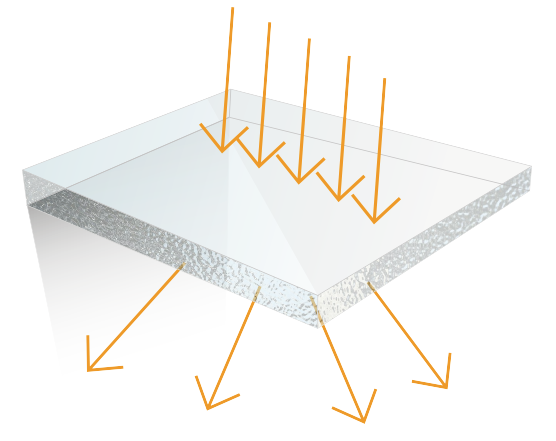
Generally speaking, we can understand the concept of haze as the ability to scatter light. As shown in the figure above, the light is scattered.
The greater the haze, the stronger the material's ability to scatter light, and the less clear it is for our human eyes. For example, frosted glass, standing on the other end of the glass, the human eye cannot see the scene on the other side of the glass clearly, but the glass can transmit light. (The wall also cannot see the other side, but the wall blocks the light.)
In the mobile phone and automobile industries, it is often necessary to measure the parameter of haze.
The written explanation is: the ratio of the scattered luminous flux that deviates from the direction of the incident light through the sample to the transmitted luminous flux, expressed as a percentage. Usually only the scattered light flux deviated from the direction of incident light by more than 2.5 degrees is used to calculate the haze.
Transmittance
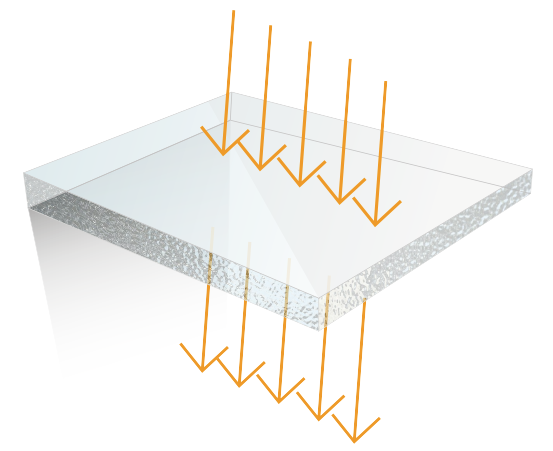
The transmittance is relatively easy to understand. It can be understood as the ability of light to penetrate the material, and has nothing to do with the direction of light propagation after transmission. The higher the transmittance, the more light passes through. For example, glass windows and curtains, glass windows require light transmission, and curtains require light penetration as much as possible.
With the advent of the intelligent era and the rise of touch screens, there are high requirements for the transmittance of many materials. Many materials need to be tested for transmittance, and often, transmittance and haze generally need to be tested at the same time.
For the transmittance, the written interpretation is: the ratio of the luminous flux passing through the sample to the luminous flux incident on the sample, expressed as a percentage.
refraction
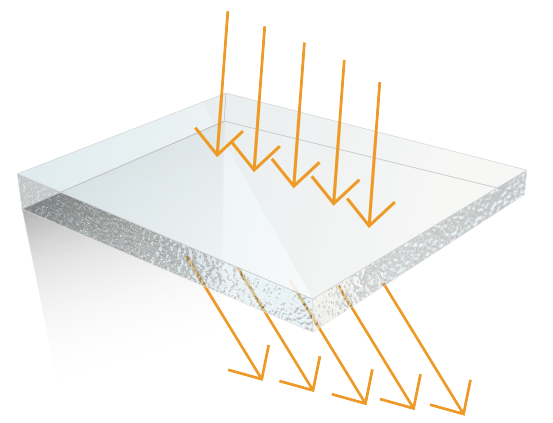
We are no strangers to the phenomenon of light refraction, so what is the difference and connection between haze and refraction?
Refraction is a kind of light passing through a certain medium, and the direction of propagation will change. This kind of angle change is certain. From the perspective of sensory experience, that is, you can still see the opposite scene clearly, but the position has changed. The real example is that the chopsticks bend in the water, but the underwater part still looks like chopsticks. .
However, the haze can be understood as the refraction in different directions due to the material, which forms the scattering of light. At this time, it is impossible to see the opposite scene clearly.
Rigorously describe refraction: when light is obliquely incident from one transparent medium into another transparent medium, the propagation direction will generally change. This phenomenon is called light refraction.
Gloss

Gloss is actually a completely different concept from the above three. The above three are transmission phenomena for transparent objects, while gloss is for the specular reflection of light on the surface of an object.
Gloss can be understood as the subtle "roughness" of the surface of an object. That is, the smoother and more "reflective" the surface is, the "brighter" it feels to the human eye, and the higher the gloss.
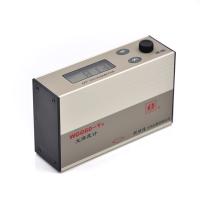
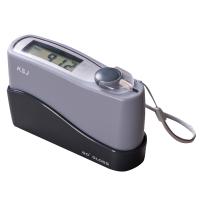
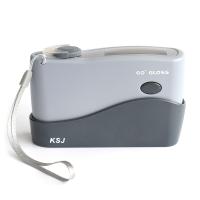
There are many industries that need to measure gloss, and gloss meters are generally used.
Written explanation: Gloss is a physical quantity that evaluates the ability of a material surface to reflect light specularly.
Note: The pictures are not scientifically rigorous and are for illustration only.