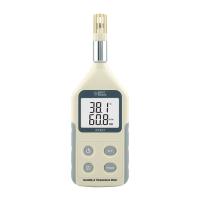
What is the temperature and relative humidity generally required by the paint factory, and how to measure them?
The temperature of the paint workshop is generally maintained at 18~25°C, and the relative humidity is 55%~70%. Dry and wet bulb thermometers are often used to measure the temperature and relative humidity.
Ordinary dry and wet bulb thermometers are composed of two identical mercury (or alcohol) thermometers, one of which is covered with two layers of gauze, and the lower end of the gauze is immersed in a small glass bottle filled with water. The method of the thermometer is wet bulb. temperature; another thermometer reads dry bulb temperature. According to the temperature difference between dry and wet bulbs, the relative humidity in the air can be found in the special table.
For example, in the second dry exercise room, the dry bulb temperature is 88°C and the wet bulb temperature is 8o°C. According to the difference between the dry bulb thermometer and the wet bulb thermometer, which is 8, the relative humidity in the room can be found to be 71% in the relative humidity table of the two values.
What effect does temperature and relative humidity in the paint shop have on paint drying?
The temperature and relative humidity of the air have a great influence on the natural drying of the sub-paint:
(1) For volatile paints, the temperature is high and the drying is fast; the temperature is low and the drying is slow. The relative humidity has a great influence on the performance of the paint film. When the relative humidity is above 70%, the paint film is very easy to turn white.
(2) For oxidative polymerization paints, the temperature is high and the drying is fast; the temperature is low and the drying is slow. When the relative humidity is below 65%, the effect of drying is not great, but when it exceeds 70%, the phenomenon of slow drying is very obvious.
(3) The drying of lacquer is different from the above two types of paint. Under the conditions of 20~30℃ and relative humidity of 75%~80%, the catalytic activity of laccase is stronger, while the drying of lacquer is faster and better, and it only takes 12~24 hours to dry. If the temperature is low, the air is dry, and the laccase activity is poor, it will take about half a month for the lacquer to dry , and the quality of the paint film is extremely poor. In the Yangtze River Basin of CHINA, the temperature in the Huangmei season is about 25°C and the relative humidity is about 80%, which is suitable for the activation of laccase. Therefore, the lacquer is applied in the Huangmei season, and it dries quickly and has good quality.
What are the requirements for the paint construction site?
(1) The temperature and humidity of the paint site should be appropriate. Most paints should be finished under normal temperature conditions, too high or too low temperature is not suitable. Therefore, heating facilities should be installed in the painting site so that it can reach the normal temperature range in winter; paint construction should also be carried out under suitable humidity, that is, the relative humidity of the air is 45%~6o%, which is more suitable, so the painting site should not be too dry and cold. too wet.
(2) The light in the painting place should be sufficient and bright. This is necessary for many processes in paint construction, especially painting, color matching, color matching, etc. When the site is not well lit, not only the color cannot be found accurately, but also problems such as missing brushes or sagging are prone to occur during painting.
(3) The paint site should be clean. If the construction environment is unclean, dust will fall on the surface of the paint film, resulting in graininess and roughness.
(4) The site of the previous process should be separated from the site of the subsequent process. Dust and wear debris are likely to be generated in the previous process of paint construction, so it should be combined with the finishing process and other processes in the subsequent process.