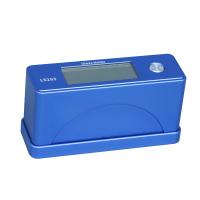
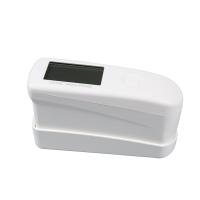
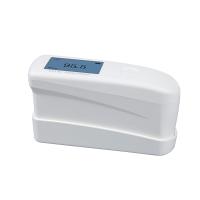
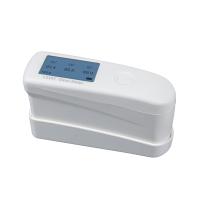
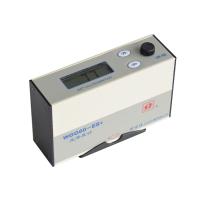
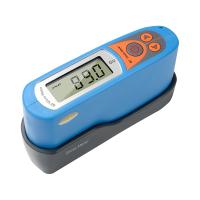
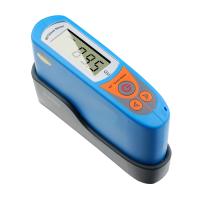
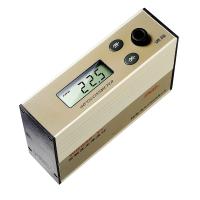
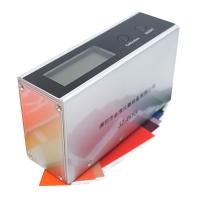
With the development of my country's economy and the improvement of people's living standards, indoor and outdoor decoration tends to be high-end and luxurious, and the demand for high-grade stone materials is increasing substantially every year. Improving the surface gloss of stone materials after fine grinding and polishing is the key to improving the grade of stone materials. The appearance of the gloss meter also played an important role that needs no repeating.
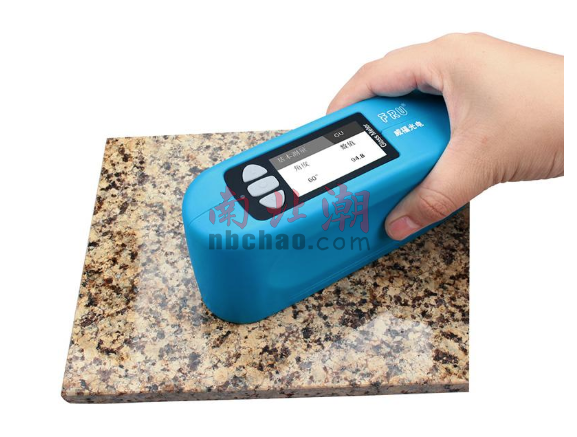
In this paper, based on the research on the formation mechanism of the glossy surface of stone at home and abroad, combined with the research progress of ceramic and glass precision processing technology, high-quality stone is obtained through two precision processing methods with completely different processing conditions: free abrasive polishing and ELID grinding. The surface of the stone is processed, and a variety of detection methods are used to track the change of the surface characteristics during the grinding and polishing process of the stone, and the formation of its surface gloss and its dependence on the microscopic roughness of the processed surface are studied in combination with the properties of the stone:
1. The surface roughness of the stone is very scattered, and the surface roughness value varies by 3-4 times at different positions. The observation results of microscopic morphology show that there are defects such as pits, cracks, grain boundary cracks, and grain shedding on the polished surface of the stone, which are the reasons for the dispersion of the surface roughness of the stone.
2. The level of surface gloss depends on the size of its roughness. As the surface roughness decreases, the surface gloss increases, and only after the surface roughness decreases to a certain level, the surface gloss of the stone surface will increase sharply. But when the surface roughness value is relatively low, the increase in surface gloss is very small.
3. The glossiness of the stone surface is also closely related to the defects of the material itself and the residual pits on the surface. Tracking the changes in stone surface morphology during the polishing process found that some of these pits are inherent in the stone itself, and the other part is the pits caused by rough grinding that cannot be eliminated during polishing and remain.
4. On the basis of considering the influence of material defects and residual pits on the surface gloss, the concept of zero-defect gloss is proposed. This definition helps to quantitatively evaluate the impact of processing defects on surface gloss, and can be used to predict the highest gloss that can be achieved by actual polishing stones.