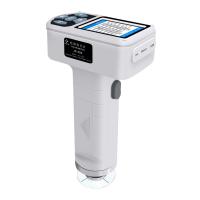
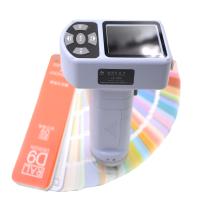
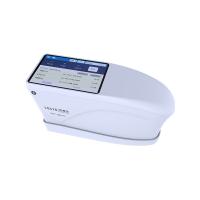
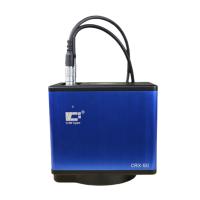
The Spectrophotometer adopts the principle of spectroscopic color measurement, divides the reflected light into intervals of 5 or 10 nm, and obtains a total of 40 or 80 sets of reflectance data at different wavelengths. Compared with ordinary Colorimeters, it is more expensive in price.
Color difference meter: use three primary color filters (red, green and blue) for spectroscopic analysis. Analyze the ratio or light intensity of red, green, and blue light. Obviously, the amount of data obtained is much less than that of a Spectrophotometer , so the accuracy is slightly lower, and simple color difference measurement can be done.

Classification of Spectrophotometer
1. Desktop color measuring instrument: Due to the inconvenient movement, it is suitable for color development in the early stage and color monitoring in the production process, so the accuracy is very high.
2. Portable color measuring instrument: It is often used for raw material entering the factory, batch color difference control, and the color of the finished product is consistent with the quality inspection of the factory.
Components of a Spectrophotometer
Visible light Spectrophotometer consists of the following 5 systems:
①, lighting system
It consists of a light source and an illumination optical system. Light source requirements need to be able to emit a continuous spectrum over the entire operating wavelength range (visible light). Typically pulsed xenon lamps are used.
②, spectroscopic system
Divide the mixed light leaving the integrating sphere into monochromatic light of different wavelengths, which is the unique spectroscopic function in the visible light Spectrophotometer . There are many light splitting methods, which will not be introduced in detail here. The result of spectrometry is to obtain the absorption and reflection of the measured object to visible light of different wavelengths - the visible spectrum reflectance curve.
③ Photometric system
The solution of the photometric system is how to reasonably arrange the light reflected from the measured object and the light directly emitted by the illumination beam. Generally, the dual optical path spectrum analysis technology as shown in the figure below can be used to distinguish the light reflected from the measured object from the light emitted by the illumination beam. The other is the single light path, which means there is only one light path, and there is no lower light path. The disadvantage of a single optical path is that the instrument needs to be stable during the entire test period when measuring standards and samples (sometimes measuring multiple samples in succession). Otherwise the results fluctuate wildly.
④, receiving system
The photoelectric signal is converted by the photoDetector, and then amplified
⑤. Control and data processing system
The function of this system is self-evident, process the data, get the result of the color measurement. In fact, what the visible light Spectrophotometer measures is only the property of the measured object of the object - the spectral reflectance curve. In the three elements of object surface color (light source, object, observer), light source and observer are constants for the other two elements, which are fixed and stored in the control and data processing system.