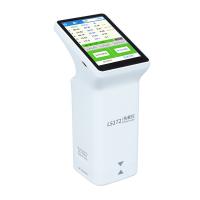
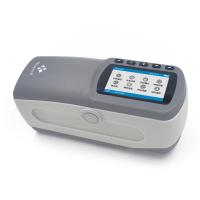
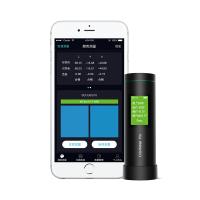
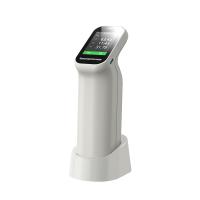
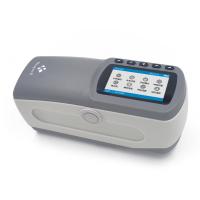
This article mainly introduces the analysis of the possible causes of errors in the test process of the color difference Tester, and why there are errors in the test results of the color difference Tester? Many users use the color difference Tester improperly in the process of operating the color difference Tester, or do not choose the correct color difference Tester product, and the test results will not be accurate enough.

Possible reasons for Colorimeter test error:
1. Differences in the working principles of different Colorimeters
The color difference meter that is often said is a color difference detection device developed by imitating the principle of human eye color perception. It consists of three parts: lighting system, detection system and data system. The lighting and detection parts can be divided into "0/45" and "45" /0", "d/0", "d/8" and other measurement and observation methods. Among them, "0/45" and "45/0" are designed to simulate the viewing angle of the human eye. The light source is incident at an angle of 45° and measured at an angle of 0°. This measurement method is generally aimed at flat objects. For irregular surface, it is difficult to measure accurately. The "d/8" integrating sphere Colorimeter uses a white-painted ball to diffusely illuminate the sample and measure at an angle of 8°. This structure can better test the reflection of solids and the transmission of liquids. The data system can directly present the color parameters of the measured object in the form of numerical values, and according to the tristimulus value chromaticity coordinates specified by CIE, through a series of transformations, it is expressed as easy-to-understand L*, a*, b*, Through these three values, the color of the measured object can be accurately expressed.
Due to the different working principles and different measurement methods of the selected Colorimeters, the results of the color difference values obtained will be different.
It needs to be specially explained here that even with the same type of Colorimeter equipment, there may be deviations in the results of measuring the color difference of the same object. The standard plates of different Colorimeters are different. Generally speaking, the normal difference between the same model of Colorimeters will be controlled within ΔE*ab 0.2, and the parameter settings of the two Colorimeters are inconsistent, which may also lead to large errors in measurement values. For example, the choice of light source and angle.
2. Light source parameters
Many Colorimeters are equipped with a variety of light sources. The Colorimeter light source here refers to the artificial light source that simulates various ambient light stipulated by CIE, such as standard light source D65, A light source, etc. The relative spectral distribution is similar to the CIE standard. The relative spectral distribution of the illuminant. As far as the measurement value of the Colorimeter is concerned, the selection of a suitable detection light source is also important for the accuracy of the measurement results. If the selected light source is inconsistent, the measurement results will also be different.
3. Angle of field of view
When we choose a Colorimeter, we often find such a parameter: the observer angle is 2°/10°. The observer angle here refers to the field of view angle during measurement. The formation of the angle of view is related to the structure of the human eye. In order to more accurately simulate the process of seeing colors with the human eye, different angles of view are selected, and the results of the color difference evaluation will also be different. However, according to literature analysis, there is no significant difference in the measurement results of 2° and 10° under A light source.
4. Temperature during measurement
The temperature change detected by the Colorimeter will also affect the accuracy of the measurement results. The color change due to temperature changes is a physical phenomenon. Different materials have different thermal discoloration properties. If it is some temperature-sensitive materials, then if the temperature is inconsistent during measurement, the result of the Colorimeter test will be sure. There is also a difference.
5. Operation error
When using the Colorimeter, the user's own improper operation will also lead to inaccurate measurement results. For example, the power supply voltage of the Colorimeter is unstable, and the light source is unstable; the calibration plate cannot be calibrated successfully; the measurement area of the measurement sample is too small, less than the area of the instrument lens, etc. It is used to correctly complete the color measurement steps according to the operating specifications of the Colorimeter. For detailed operation methods, please refer to the article "Working Principles and Operation Procedures of the Colorimeter".
Why is the dark color inaccurate in the Colorimeter test?
Generally speaking, black and dark blue are colors that are difficult to control in the color management process. Since black has very little reflection of visible light, conventional Colorimeter products are measured by the reflected light on the sample surface. Therefore, dark colors are relatively Medium or light colors are more difficult to measure. To determine if the color matches, the manufacturer measures the target color and the resulting sample, then compares the spectral data. Color tolerance limits, also known as allowable color variations, provide guidance on acceptable color variations. This color difference is called ΔE.

What should I do if the deviation of the Colorimeter test is too large?
During the measurement of the Colorimeter, if the measurement results are very abnormal, the user needs to analyze the cause of the excessive deviation. The verification method has the following steps:
1. Calibrate the Colorimeter. If the Colorimeter is not calibrated accurately, there will be large deviations in the measurement results.
2. Check whether the power supply voltage of the instrument is normal. If the power supply of the instrument is insufficient, the normal operation of the instrument cannot be guaranteed during measurement, and the measurement results will also have large deviations.
3. Check whether the measurement sample is flat. If the measurement port is not in close contact with the measurement surface, it will cause the interference of external light, resulting in wrong color difference test results.
4. Check whether the surface of the tested sample is clean and whether there is any color mixing of impurities. If the color of the tested sample is mixed, it is difficult to accurately evaluate the measurement results.