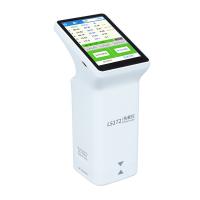
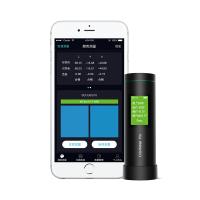
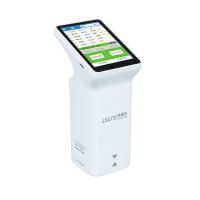
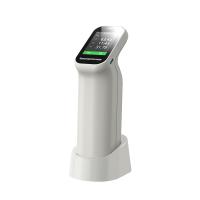
What is the measurement result of the Colorimeter? What is the unit? When using the Colorimeter, many users do not know the meaning of the units of the above measurement results and the specific expressions. This article will briefly introduce the basic knowledge of the Colorimeter.

What is the unit of color difference?
The color difference meter is widely used in the field of color management in plastics, printing and dyeing industries. It is mainly based on the CIE color space Lab, Lch principle to detect the degree of color difference between the sample and the tested item. The chromatic aberration is also called the hue difference. The modern chromatic aberration evaluation is based on the standard chromatic aberration formula suggested by the International Association of Illumination (CIE) and calculated by instruments and computers. It is expressed in accurate numbers, and CIE 1976L*a*b* is often used. and CIE 1976L*u*v* and other color difference formulas to calculate the color difference.
The NBS color difference unit is currently a standard unit for people to measure color difference. This is the absolute value 1 calculated by the Y1/2, a, b color difference calculation formula as a unit. It is the color difference calculation formula implemented by the National Bureau of Standards in 1939. One NBS unit is approximately equivalent to 5 times the visual color difference recognition threshold. If compared with the color difference values of adjacent two levels in the Munsell system, 1NBS unit is approximately equal to 0.1 Munsell lightness value, 0.15 Munsell chroma value, 2.5 Munsell hue value (chroma is 1); The difference between two adjacent colors in the Munsell system is about 10NBS units. As for the range of product color differences that should be allowed, it should be determined according to the difference in people's color perception.

What is the unit of the Colorimeter?
The 1NBS color difference unit is actually a unit under the color difference calculation formula, but many high-precision color difference meter products on the market contain multiple color difference calculation formulas. In this case, we cannot say that NBS is the unit of the color difference meter. Although the units of different color difference companies are roughly the same as the NBS units, there are actually certain differences. Therefore, when applying different color difference formulas, the units of the color difference meter are actually different.
The NBS unit has been used as the unit of all color difference calculation formulas for a long time, but after the 1970s, with the emergence of a large number of color difference formulas (such as the above CIE 1976L*a*b* and CIE 1976L*u *v*), using the same standard unit of calculation is imprecise and unnecessary. In order to express the color difference value more scientifically, people will directly use △ECIE and △ECMC instead of using NBS unit.
It can be seen that the color difference meter does not have a fixed unit, so the user only needs to indicate the color difference calculation formula when expressing the measurement results.
What is the measurement result of the Colorimeter?
As mentioned earlier, different color difference calculation formulas are used for color difference meter measurement, so the measurement result data we analyze will also be different. For example, our desktop Spectrophotometer YS6060 has ΔE*ab, ΔE*uv, ΔE*94, ΔE*cmc(2:1), ΔE*cmc(1:1), ΔE*00, DINΔE99, ΔE(Hunter ) and other calculation formulas, and supports CIE LAB, XYZ, Yxy, LCh, CIE LUV, Musell, s-RGB, HunterLab, βxy, DIN Lab99 and other color spaces, which can meet various measurement needs of different users.
Data Analysis of Colorimeter
To judge the color difference value, the color space notation is commonly used in the world. Common color spaces include LAB, LCH, RGB, XYZ, YXY, etc. Of course, the commonly used value is still the Lab value, which can represent almost any color. Other colors The space is for informational purposes only, with little client attention. The following introduces the relevant meaning of the Lab value:
L means black and white, some say light and dark, + means whiter, - means darker
A means red and green, + means reddish, - means green
B means yellow-blue, + means yellowish, - means blue
All the above mentioned are relative values. Simple L, A, and B are absolute values. Using these three values can accurately represent a point of a color in a three-dimensional stereogram. Using relative values, you can get the reference point difference to correct. The CIE 1976L*a*b* uniform color space is widely used in many aspects, and it is usually used to express the measurement result unit of the Colorimeter.

In general, the unit of the color difference meter does not have a clear fixed unit, and we usually express the color difference value according to different color difference calculation formulas.