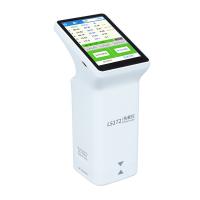
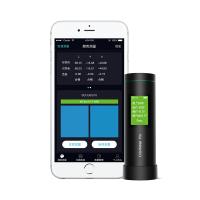
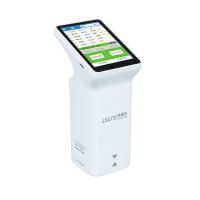
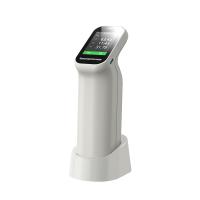
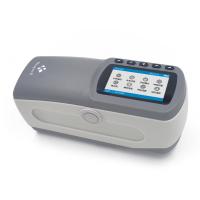
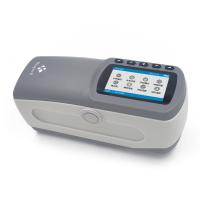
How to calculate the measurement angle of the Colorimeter? How to choose? If you are not a practitioner in the field of color management, it is actually difficult to understand the principle of the angle division of the Colorimeter. Today, I will introduce the key points for you. Interested friends may wish to take a look!

How to divide the angle of Colorimeter?
When people observe the color of the surface of an object, they are not only affected by the color of the object itself and the light source, but also the viewing angle will greatly change the color we perceive. In order to standardize the color measurement environment, CIE stipulates the standard observer angle. Of course, for the Colorimeter, the measurement angle will also have a great impact on the accuracy of the colorimetric test results.
At present, the angle of the Colorimeter is divided according to the lighting method, which can be mainly divided into 45°/0° or 0°/45° instruments and diffuse d/8° integrating sphere instruments. Among them, 0°/45° can only be used to measure smooth object surfaces, and the measurement results do not support computer color matching. The "d/ 8° integrating sphere" can measure a wider range, and the measurement data can be color-graded by professional computer color matching software.
Various "d/8 degree integrating sphere" Colorimeters are also different: for example, "dual-beam measurement principle" or "single-beam measurement principle". Dual beam instruments have two gratings and two Detectors. The light source only flashes once during the measurement, and the sample and reference white are also measured. In this way, errors caused by system changes are overcome, and the accuracy of measurement data is very high. It's just that the equipment costs are high.
Generally speaking, with careful use, the optical diffuser can reduce the small errors caused by the uneven distribution of the incident light source on the Detector or the beam deviation during the measurement, thus improving the accuracy of the measurement. However, in precise measurement, it is necessary to use an integrating sphere as an optical diffuser to minimize the above-mentioned errors.
Working principle of Colorimeter angle
The Colorimeter is a detection instrument that simulates the human eye's sensitivity to red, green and blue light, and can analyze the measured object from multiple angles. Generally speaking, angles of 15°, 45°, and 110° are often selected for analysis.
Any color measured here can be perceived and measured by the Lab color representation method. where L represents brightness,
100 is white; a means red and green, positive value is red, negative value is green, 0 is neutral color; b means yellow blue, positive value is yellow, negative value is blue, and 0 is neutral color. The color difference between the sample and the standard sample can be easily expressed through Lab. Usually, Δa, Δb, and ΔL are used as identifiers, and ΔE is defined as the total color difference of the sample, but it cannot indicate the shift direction of the color difference of the sample , the greater the value of ΔE, the greater the color difference. The color difference meter can measure and display the color difference ΔE and Δa, Δb, ΔL values of the sample and the standard sample according to the Lab and Lch principles of the CIE chromaticity space.
How to choose the correct angle of the Colorimeter?
The color difference meter is a detection instrument that quantifies color phenomena. It expresses the color difference through various values. It is also an indispensable tool for computer color matching in the next step, in order to make the color difference detection results more accurate. We need to choose a Colorimeter to measure the angle.
At present, the common angles of Colorimeters on the market are the "0/45 degree" and "d/8 degree integrating sphere" mentioned above. "0/45 degree" is the closest structure to the angle of human observation, so this The color information measured from this angle is the closest to the observation result of human eyes. However, its measurement range and measurement data processing have considerable limitations, so it is not recommended to use it.
"d/8 degree integrating sphere" is based on the principle of spectrophotometric color measurement of integrating sphere. It has four main components: light source, integrating sphere, grating (spectral monochromator) and photoDetector. The integrating sphere can be used to test the luminous flux, color temperature, light effect and other parameters of the light source.
The measurement results are more accurate, and the measurement results can also be used for the next step of computer color matching.