Text, Purpose and Significance
It is to compare varnishes, varnishes, paints and thinners with a series of glass or solutions of standard color scales, and observe the depth of the color under natural scattered light or under the transmitted light of a fixed artificial light source
The determination of color is not only a quality indicator of the product, but also a control item for some raw materials or semi-finished products. Because the composition and purity of the oil can be comprehensively reflected from the depth of the color, and the depth of the product color will directly affect its film-forming performance and application range. The varnish with deep color is not suitable for making varnish, and the prepared self-colored paint tends to have a yellowish phase, and the red paint appears dark and so on.
Related standards
GB/「1722_92 Method for Determination of Color of Varnishes, Clear Oils and Thinners
GIl/T9281-88 Furfur-based Gardner Color Scale for Color Bonding and Varnishes for the Evaluation of the Color of Transparent Liquids
GB pays 9282-88 transparent liquid with platinum-cobalt grade to evaluate certain color
Key points of inspection methods
3.1 GBfI'1722_92 Color determination method for varnishes, varnishes and thinners
3,11 iron-cobalt Colorimeter method
3.1.1.1 Test principle
At a certain temperature, place the sample under the transmitted light in an artificial daylight colorimetric box or a wooden dark box for visual comparison with the standard color scale number to determine the color number of the sample
3.1.1.2 Materials and equipment
Colorless glass test tube: inner diameter 10.75mm, length l14mm.
Standard color scale solution: 18 standard color scale solutions prepared by dilute hydrochloric acid solution of fast trichloride and cobalt fluoride. The color is from light to dark, No. 1 is the lightest, and No. 18 is the darkest.
The artificial daylight colorimetric box shall comply with the provisions in GBfT9761.
Wooden obscura: 500:x400x000mm
31.1.3 Operation points
Put the sample into a clean and dry colorimetric tube with an inner diameter of 10.75mm and a length of 114mm, and place it in an artificial daylight colorimetric node or a wooden dark box under the condition of (23±2)°C. , Visually compare with the standard color scale under the transmitted light at a viewing distance of 30-50 om, and select two standard color scale numbers that are closer to the color of the sample, or a standard color scale number that is the same color as the sample.
3.1.l.4 Result presentation
Record the standard color scale number that is closest to the color of the sample or is the same as the color of the sample. The number indicates the color of the sample. 3.1.1.5 Precautions
①Before the measurement, check whether the colorimetric tube is clean and transparent, otherwise it cannot be used.
② If the sample is muddy due to low temperature, it can be heated to (50~55)°C on a Water Bath, kept for 5 minutes, then cooled to (23±2)°C, and then measured.
③ When measuring, when the hue is different, the hue can be ignored, and only the depth is compared.
④ The iron-cobalt Colorimeter should be kept properly and protected from sunlight. Calibration every three years.
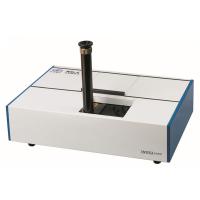
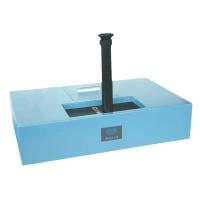
3.1,2 Lovibond colorimetry
3.1.2,1 Test principle
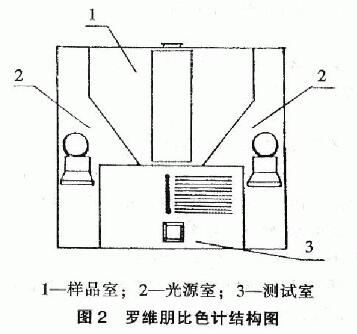
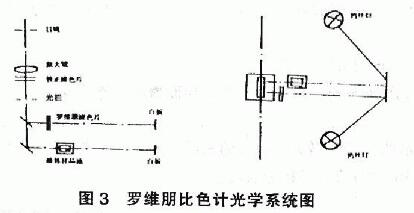
Put the sample into the sample crystal cell (cuvette), and use the red, black, and blue primary color filters marked with Luo Tongpeng chromaticity value to visually match the sample. When the matching color is consistent with the sample color , represented by the unit value of the chromaticity scale of the three color filters. The color of the sample.
3.1.2.2 Materials and equipment
Sample cell: l0.0mm, used for measuring dark-colored samples; 25.4mm, used for measuring light-colored samples; l33.4mm, used for measuring light-colored samples. The optical system of the Lovibond Colorimeter is shown in Figure 3.
3.2.2 Materials and equipment
Gardner color number: Eighteen glass colors and liquid colors.
Colorless glass test tube: inner diameter about 10.65mm, outer diameter about 12.5m, outer wall length about l14n,,n.
Colorimeter; C light source is used for lighting, and the environment should be non-color. 13.2.3 Operation points Pour the sample into a clean test tube, put it on the sample holder of the Colorimeter, turn on the light source, and conduct visual observation at a viewing distance of 30-50cm, and compare the sample with the standard number close color.
3.2.4 Result presentation
The color of the sample is indicated by the standard number that is closer to the color of the sample
3.2,5 Precautions
3.2.5.1 This standard applies to drying oils, varnishes, fatty acids, polymerized fatty acids and resin solutions.
3.2.5.2 If there is visible oil mixed in the sample, it needs to go through waves.
3.2.5.3 During the measurement, the height of the sample loaded into the test tube should not be lower than 70mn
3.2.5.4 The test results should indicate whether the glass color standard or the liquid color standard is used, and the sample is filtered.
3.3Gllf "9282-88 transparent liquid sold in platinum - rating color
3.3.1 Measuring and forming principle
Compare the color of a sample with the platinum-cobalt color standard and express the results in platinum-cobalt color units.
3.3.2 Materials and equipment design
Colorimetric tube: capacity is l00m1, with ground glass stopper.
Colorimeter: There should be baffles at both ends of the Colorimeter to prevent light from entering the colorimetric tube from the side.
3.3.3 Operation points
Pour the sample into a clean test tube, put it on the sample holder of the Colorimeter, turn on the light source, conduct visual observation at a viewing distance of 30-50 cm, and compare the color accuracy of the sample with that of platinum-cobalt cloth. close color.
3.3.4 Result presentation
The color of the sample is expressed by the number of platinum cobalt units closer to a certain standard color.
3.3.5 Precautions 3.3.5.1 This standard 1 is suitable for transparent liquids whose color is similar to that of platinum-cobalt grade standard.
3.3.5.2 If the sample is turbid and becomes visible impurities, it should be professionally filtered.
3.3.5.3 When the color of the sample is between two standard colors, the darker color shall be taken as the result.
3.3.5.4 When the hue of the sample is different from that of the standard color and it is difficult to judge the result comparison, an explanation should be made on the color of the sample.