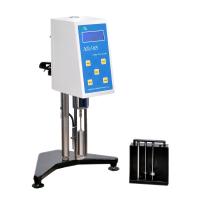
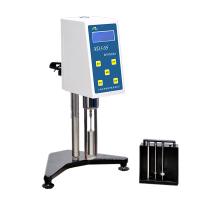
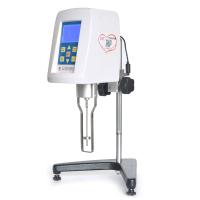
Viscosity is an important physical property of fluids. Samples such as paints, coatings, and oils need to be measured for viscosity, and viscometers are generally used for testing. This article is excerpted from Zhou Lijuan's "Viscometer Verification Influencing Factors Analysis and Verification Error Reduction Method", mainly sharing what factors will be affected during the viscometer verification process?
1. Temperature affects viscometer verification
Newtonian internal friction is related to the interaction . When the temperature rises, the thermal movement of molecules will increase the distance between molecules, so that the attraction between molecules will decrease, and the Newtonian internal friction will also decrease . Therefore, fluid viscosity and temperature is negatively correlated. The experimental results prove that the viscosity change rate of refined methyl silicone oil and refined petroleum is : for every change of fluid temperature ± 0.1°C, the viscosity of refined methyl silicone oil changes by ± 0.2%, and the viscosity of refined petroleum oil changes by ±0. 5%.
Table 1 Relation between viscosity value of refined silicone oil and temperature change temperature

It can be seen from Table 1 that every 1°C change in temperature will affect , and as the temperature increases, the viscosity value tends to decrease. To control the temperature of the fluid, it is generally necessary to control the deviation of the temperature within ±0.1°C, otherwise it will have a great impact on the test results .
2. There are defects in the viscometer
When performing viscometer verification , it is not enough to conduct general appearance inspection. The uniformity and inner diameter control of domestically produced capillary viscometers are not as strict as those of imported viscometers . The measurement constants of two viscometers marked with the same inner diameter can sometimes be 1 times different. If there are too many, it will easily lead to improper selection of standard viscosity materials, resulting in an increase in measurement uncertainty. Too fast and too slow outflow time are not conducive to the measurement of outflow time. In addition to checking the nameplate of the instrument, instrumentthe production and the use of the power supply, the rotary viscometer . The hour hand should be at zero.
3. Improper cleaning and operation of the viscometer
The viscometer should be cleaned before the verification of the viscometer . Cleaning the viscometer is a cumbersome task, but the incomplete cleaning of the viscometer will have a great impact on the verification results of the viscometer. If some impurities remain on the inner wall of the viscometer , it will affect the flow resistance of the tested sample in the viscometer and directly affect the outflow time. In the verification process, the measurement accuracy or repeatability error is often encountered because of irregular cleaning. At this time, re-cleaning will greatly increase the workload. The rotor and outer cylinder of the rotary viscometer also need to be cleaned. You can choose a suitable organic solvent for cleaning. Do not use hard objects for scratching. Scratches on the surface of the rotor will cause inaccurate measurement data.
The operation of the capillary viscometer is prone to non-standard liquid filling, improper adjustment of verticality, inaccurate and excessive vibration, which will cause the verification results to be out of tolerance. The outflow time is related to the acceleration of gravity and the height of liquid filling. For the same verification location, when the acceleration of gravity remains unchanged , it is only related to the height of liquid filling. error. Therefore, the verification of the capillary viscometer must strictly control the filling height of the viscosity standard substance. If the capillary viscometer is tilted, there is a component in the acceleration due to gravity , which can also lead to a longer efflux time.
Table 2 Calibration errors caused by capillary viscometer tilt

It can be seen from Table 2 that when the inclination angle is 1°, an error of about 0.2% will be caused to Ubbelohde's and Finn's viscometers , and an error of about 0.5% will be caused to Ping's and countercurrent . The verification requires an electronic stopwatch with a division value greater than 0.1s, and the repeatability verification result should be controlled within the range of 0.05%. When the lowest point of the viscosity standard liquid is tangent to the timing ball, the timing is performed, and eye-hand cooperation is required. , to achieve accurate timing. The verification device of the capillary viscometer should be far away from the vibration source to ensure that the liquid starts to move only under the action of natural gravity. During the verification process, the verification device should not be collided to avoid disturbing the flow of the liquid.
During the verification work of the Rotational Viscometer, it is found that problems such as mismatching of the measuring container, improper selection of the rotor, incorrect speed setting and non-standard depth of the rotor immersed in the liquid are easy to occur. The container of the Rotational Viscometer should match the rotor. In theory, the larger the diameter of the outer cylinder, the smaller the impact on the measurement. In fact, it is required that the diameter of the outer cylinder should not be lower than a certain size. The experimental results show that when the diameter of the outer cylinder is lower than a certain size It will obviously increase the measurement error. During the verification, the appropriate rotor should be selected according to the standard value of the viscosity. For the standard choose the small-volume rotor No. 3 and No. 4, and for the standard solution with a small viscosity value, select the No. 1 and No. 2 large-volume rotor. The torque generated should be controlled at full capacity. The range is between , and the rotor should be placed at the center of the liquid to be measured. Then, adjust the speed to make the rotor rotate at a constant speed, and keep the pointer at about 50% as much as possible to reduce the verification error. If the torque is too large, it may cause damage . Pay attention to check whether there are air bubbles attached to the surface and bottom of the rotor. If there are air bubbles, it will cause a large verification error. In addition, it should also be noted that the power supply frequency of some rotary viscometers imported from Europe, America and Japan is 60Hz , which is inconsistent with the 50Hz in CHINA. It needs to be corrected according to "actual viscosity = indicated viscosity × nominal frequency ÷ actual frequency ", otherwise a 20% error will occur .