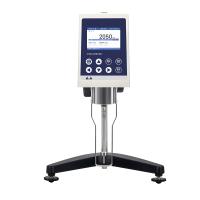
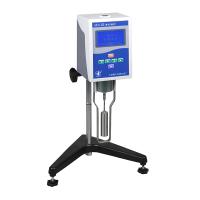
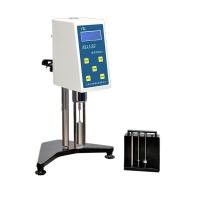
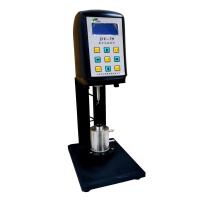
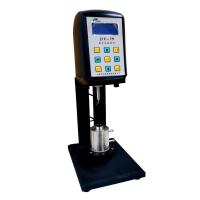
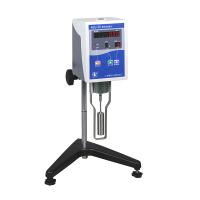
The basic principle of the rotary viscometer is: a synchronous micro- motor drives the drum to rotate in the measured fluid at a certain speed. Due to the action of fluid viscous force, the drum will lag behind . The elastic element will produce a certain twist in the opposite direction of rotation , and the sensor will measure the magnitude of the torsional stress, thereby obtaining the viscosity value of the fluid.

Figure 1 Rotational Viscometer
The types of Rotational Viscometers are classified according to the structural characteristics of the torque transmission device (including the measuring head and the sample cup), mainly including coaxial cylinder viscometers, cone-plate viscometers, and parallel-plate viscometers. The torque transmission device of the coaxial cylinder viscometer is composed of a cylindrical measuring head and a cylindrical sample cup (as shown in Figure 1), which is the most common structure. The special feature of the torque transmission device of the cone-plate viscometer is that its measuring head is in the shape of a cone with a very blunt angle, and correspondingly, its sample cup is in the shape of a flat plate. A parallel plate viscometer is like a "squashed" coaxial cylinder viscometer, where the measuring head and sample cup are flat.
For different Rotational Viscometers, the calculation formula of viscosity is also different. The formula for calculating the viscosity of a common coaxial cylinder rotary viscometer is:

In the formula:
M is the viscous moment;
h is the height of the inner cylinder;
ω i is the angular velocity of inner cylinder rotation;
R i is the radius of the inner cylinder;
R a is the radius of the outer cylinder.
The rotary viscometer is a relatively precise instrument, suitable for measuring both Newtonian and non-Newtonian fluids. It is easy to use, fast and convenient to measure, accurate and reliable data, and has a wide range of viscosity measurement (about 1~10000000mPa•s). By adjusting the rotation speed, it can measure fluid viscosity at different shear rates, which is convenient for continuous measurement. However, the Rotational Viscometer also has some disadvantages, such as it is suitable for measuring fluids at low shear rates (<10s -1 ) , has high requirements on motors and machinery, the structure of the supporting part is easily damaged, and the repeatability is poor.
Rotational viscometer is a kind of viscometer . In recent years, with the improvement of industrial production requirements, researchers have made many improvements to the rotary viscometer with single structure and function. For example, VC Kelessidis and others corrected the measurement results of the Rotational Viscometer on the basis of considering the end effect ; Ding Xiaojiong discussed some problems in online measurement; Lu Zejian added a single-chip microcomputer control to the viscometer; Sensors and digital technology . These improvements have overcome some disadvantages of the traditional measurement method to a certain extent , improved the accuracy and readability of the measurement results, expanded the application range of the Rotational Viscometer, and improved the automation of the viscometer measurement. Real-time monitoring and control of product viscosity during production brings great convenience to industrial production.