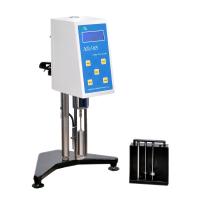
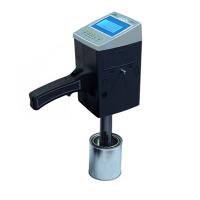
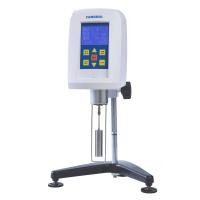
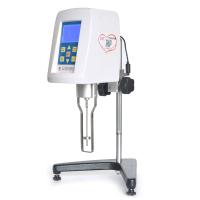
The vibratory viscometer works on the principle of shear stress. When a vibrating rod or vibrating plate is inserted into the fluid, the vibration amplitude will change due to the change of fluid viscous damping , and the vibration in high-viscosity fluid is much higher than that in low-viscosity fluid. The vibration decays quickly, so the rate of decrease of the amplitude can be used as a measure of the viscous force of the liquid. If the energy consumed by the viscous damping of this part of the fluid is supplemented by the circuit, so that the vibration of the sensitive element is maintained at the resonance frequency and constant amplitude, the viscosity of the fluid can be determined accordingly.

There are two main types of vibrating viscometers. In addition to the above-mentioned vibrating plate type, there is also a torsional vibration type. Unlike vibrating plate viscometers, which use a fixed force to pull a smooth sheet and vibrate up and down in the liquid, the viscosity of the liquid is determined by the amplitude of the sheet. The principle of the torsional vibration type is that the stepping motor drives the sample cup to rotate. The speed at which the swing decreases can be used as a measure of the viscous force.
The vibrating plate viscometer is more common. The advantage of this method is that it can measure liquids with a large viscosity range continuously or intermittently. The viscosity can be calculated by the following formula:

In the formula:
fa and f are the resonant frequencies of the sheet in air and liquid;
Ea and E are the vibration amplitudes of the sheet in air and liquid;
K0 is the instrument constant;
RM is the dynamic resistance component of the liquid;
A is the area of the sheet.
The vibrating viscometer has a simple structure, fast response time, easy range conversion, low heat generation at the shear rate of height measurement, high degree of automation, and is not affected by liquid level fluctuations and turbulence. It is a suitable for direct installation on industrial processes. Viscometer for continuous monitoring and control of viscosity. However, this viscometer is not suitable for the viscosity determination of non-Newtonian fluids, and the measurement range of the viscosity is small, usually less than 10 3 mPa•s.
Vibration viscometers can measure , and are widely used in petrochemical, paper, rubber and other industries. It was born in the United States in the early 1950s, and has been widely used in foreign industrial production, while domestic research and development work was carried out relatively late.