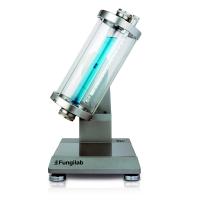
The Falling Ball Viscometer is based on the Hoeppler measurement principle for simple and accurate dynamic viscosity measurement of transparent Newtonian fluids. The core idea is to measure the time it takes for a falling ball to fall through a sample filling tube tilted at a working angle under the action of gravity. The sample fill tube is mounted on a center bearing that allows the sample tube itself to be flipped over quickly through 180 degrees, allowing immediate repeatable measurements. The measurement results are the average time taken for the falling ball to land in 3 measurements. A conversion formula is then used to convert the time reading to a final viscosity value.
The included angle between the test tube and the bottom surface of the instrument should be 10 degrees. Turn the test tube over, and use a stopwatch to record the time when the test ball falls from the A (upper part of the glass tube) ring of the test tube to the B (lower part of the glass tube) ring. The timing begins when the bottom of the test ball touches ring A and ends when the bottom of the test ball touches ring B. If the viscosity of the tested sample is very high, you can record the time for the test ball to pass through AC or CB, and then multiply it by double to calculate. Flip the test tube again and the test ball will return to the starting point. It is better to measure the average of several times under the same conditions as the falling time of the ball. The time when the test ball returns to the starting point from the end point is inconsistent with the time from the starting point to the end point (normal test time) (there will be an error of 1%). If the special measurement needs to test the time from the end point to the starting point, then the test ball The K value needs to be reset.
The formula is lower K (return) = normal test time * normal test K value / test ball return time. When testing dark samples, the bottom of the test ball is often difficult to observe. In this case, we recommend testing at the maximum diameter of the test ball (diameter at the equator) starts timing when it passes the A ring.