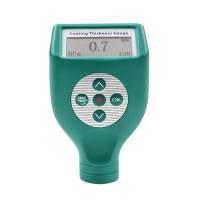
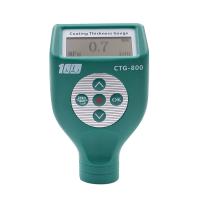
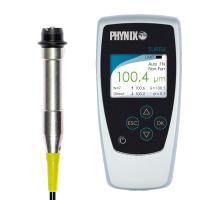
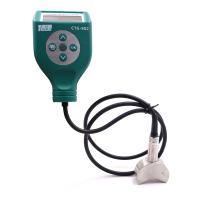
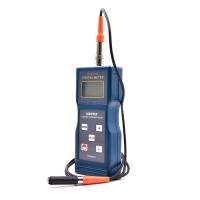
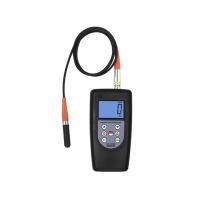
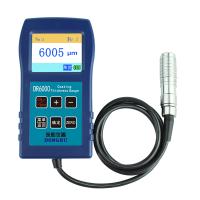
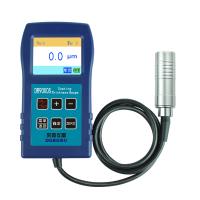
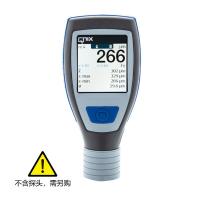
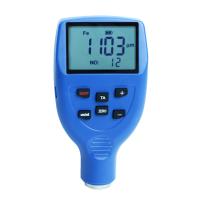
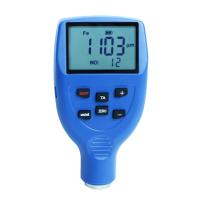
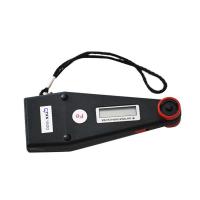
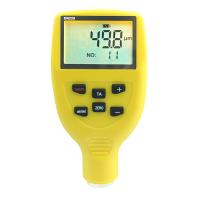
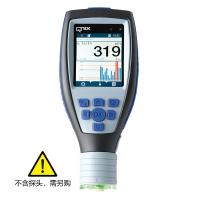
Coating Thickness Gauges (also known as paint gauges) are used to measure dry film thickness. Dry film thickness can affect the coating process, quality and cost and is therefore probably the most critical measurement in the coatings industry. Dry film thickness measurements can be used to assess coating life expectancy, product appearance and performance, and ensure compliance with many international standards.
How to measure dry film thickness?
Dry film thickness (DFT) can be measured using two methods: Destructive thickness measurement, in which a cutting machine is used to cut the coating onto the substrate. Using techniques that are non-destructive to coatings or substrates, such as magnetic, magnetic induction and eddy current thickness measurement methods, and non-destructive coating thickness measurement.
Non-destructive coating thickness measurements can be made on magnetic steel surfaces or non-magnetic metal surfaces such as stainless steel or aluminum. Digital coating Thickness Gauges are an excellent choice for measuring coating thickness on metal substrates. Electromagnetic induction is used for non-magnetic coatings on ferrous substrates such as steel, while the eddy current principle is used for non-conductive coatings on non-ferrous metal substrates.
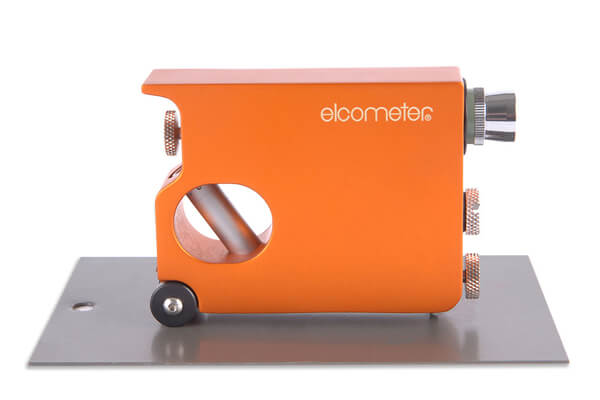
Destructive Coating Thickness Measurement

Non-destructive coating thickness measurement
How does a coating Thickness Gauge work?
Digital coating Thickness Gauges can be used to measure dry film thickness on electrical steel surfaces or non-magnetic metal surfaces such as stainless steel or aluminum. The principle of electromagnetic induction is used for non-magnetic coatings on magnetic substrates such as steel. The eddy current principle is used for non-conductive coatings on non-ferrous substrates.
1) Permanent Magnetic Coating Thickness Gauge
A permanent magnet is mounted on a balance arm, and the force required to pull it from the coated surface is a measure of the coating thickness. The force is applied via a coil spring attached to the balance arm at one end and to the dial at the other end. As the dial is turned, the force builds up until the magnet lifts off the surface. The scale is drawn in units of thickness rather than force, and the thickness of the coating can be read by a pointer on the instrument case.
2) Electromagnetic induction coating Thickness Gauge
Electronic coating Thickness Gauges for measuring magnetic substrate materials use the principle of electromagnetic induction. A three-coil probe system is used, where the central coil is powered by the instrument, while the other two coils (on either side of the central coil) detect the resulting magnetic field. The signal generated by the instrument is a sine wave, so an alternating magnetic field is generated around the central coil.
When there is no magnetic material affecting the probe, the magnetic field will cut equally into the other two coils. As the probe approaches the uncoated substrate, the magnetic field becomes unbalanced, with more magnetic field cutting the closest coils and less cutting the furthest coils. This creates a net voltage between the two coils that is a measure of the distance (coating thickness) to the substrate.
3) Eddy current coating Thickness Gauge
在涡流原理的情况下,使用单个线圈探头,其具有相对较高的频率(几兆赫兹)的信号,以在涂层下的有色金属中产生交变磁场。该磁场使涡流在基板中循环,而基板又具有相关的磁场。这些场影响涂层厚度探针并引起线圈电阻抗的变化。这些变化取决于涂层的厚度。
涂层测厚仪的精度如何?
总体上选择合适的涂层测厚仪的一个关键决定是读数需要多精确?在可用的量规类型范围内,从中等精度的量规到非常准确的量规都有发展,这反映在涂层厚度量规的价格上,精度越高,成本越高。另外,涂层的施加过程和其他因素影响特定表面上的涂层厚度的可变性,并且涂层厚度计操作者的技能和知识也影响结果。
“准确性”是什么意思?
涂层测厚仪性能的基本指标是测厚仪读取读数的准确性。那就是读数与真实涂层厚度之间的差异。
如何测试涂层测厚仪的准确性?
为了测试特定量规的准确性,拥有可追溯的涂层厚度标准非常重要。在未涂覆的光滑基材上将量规调整为零并设置为最大厚度或接近最大厚度的已知厚度标准时,将测量中间厚度标准,并将读数与标准的实际厚度进行比较。误差是读数值与标准值之间的差异。这些最方便地表示为读数的百分比。
涂层测厚仪校准的重要性?
校准是在制造过程中设置涂层测厚仪的制造商以确保该测厚仪符合要求的精度规格的过程。该程序通常要求将涂层测厚仪设置为已知的厚度值,并检查中间厚度值。在现代电子仪器中,涂层厚度范围内关键点的值作为参考点存储在量规的存储器中。
为什么在测试前需要校准涂层测厚仪?
涂层测厚仪的校准将受材料类型,要测试的金属基材的形状和表面光洁度的影响。例如,钢合金的磁性变化,并且不同的铝合金和不同的有色金属,铜,黄铜,不锈钢等的电导率也变化。这些变化会影响涂层测厚仪的线性。这意味着,例如,对于高碳钢上相同厚度的涂层,低碳钢上的量规设置将读取不同的值。在薄的或弯曲的基材上,特别是在异型基材(如用于钢结构建筑的喷砂清理钢)上,也可以看到类似的线性效应。
为了克服这些影响,大多数涂层测厚仪都具有允许您将测厚仪设置为要执行的工作的功能,从而更好地提高了读数的准确性。
调整涂层测厚仪
Tuning is a technique by which you set up your coating Thickness Gauge for the conditions of your current job. In addition to material differences, shapes and surface finishes, adjustments can also be made at high temperatures or in the presence of stray magnetic fields. By adjusting the coating thickness gage to these prevailing conditions, the resulting errors can be greatly reduced or even eliminated.
The effect of surface roughness, especially by deliberate profiling of the substrate with grit blasting or blast cleaning or by mechanical cleaning, is very significant.