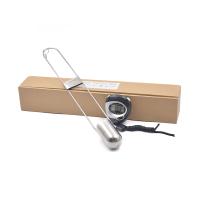
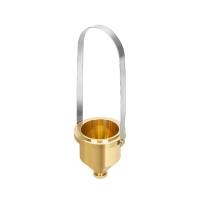
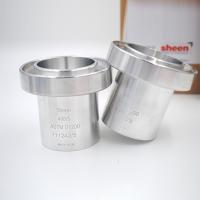
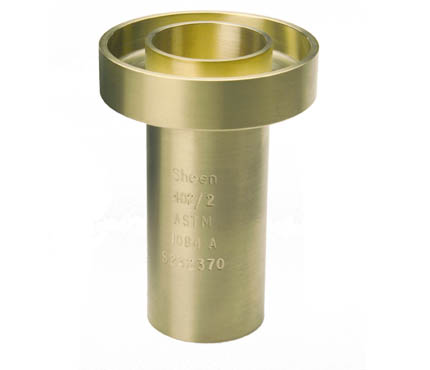
Ford (FORD) Viscosity Cup is suitable for determining the viscosity of Newtonian or near-Newtonian paints, varnishes, spray paints and similar fluids. It is to fill the Ford Viscosity Cup with the fluid to be measured, and then measure the time it takes for the fluid to flow out from the standard hole. The Ford Viscosity Cup method is very useful for the determination of many paints and other coatings and the thin-down viscosities of these materials, but is limited to the determination of the viscosity of Newtonian or near-Newtonian fluids. To obtain satisfactory and reproducible measurement results, the Ford Viscosity Cup model that meets the specified measurement viscosity range should be correctly selected. The Ford Viscosity Cup is not suitable for measuring the viscosity of materials with high viscosity and paste.

The Ford Viscosity Cup is used to measure the viscosity of chemical raw materials. Users should establish appropriate safety and health protection measures and determine rules and regulations according to relevant regulations before use. Safety issues related to contact with chemical raw materials should be established by the user and are not within the scope of this manual.
Ford Viscosity Cup is manufactured based on ASTM D1200 standard, anodized aluminum cup body, brass spout, has good corrosion resistance and solvent resistance, lightweight and can withstand wear and tear during use and cleaning. The shape of the cup is different from the style suggested by ASTM D1200, but a style similar to the ISO Viscosity Cup, which is more stable for cleaning and placement. Viscosity cups are calibrated with standard oils before leaving the factory. If the spout is loosened or taken out of the cup for some reason during use, it should be calibrated according to ASTM D1200 before it can be used again.
| model | Measuring range (centistokes) | Outflow time (seconds) |
| Ford Cup 2 | 20 ~ 120 | 40 ~ 100 |
| Ford Cup 3 | 49 ~ 220 | 20 ~ 100 |
| Ford Cup 4 | 70 ~ 370 | 20 ~ 100 |
| Ford Cup 5 | 200 ~ 1200 | 20 ~ 100 |
The conversion formula of kinematic viscosity V (centistokes) and measurement seconds t (seconds):
Ford No. 2 Cup V=1.44(t-18)
Ford No. 3 Cup V=2.31(t-6.58)
Ford Cup 4 V=3.85(t-4.49)
Ford No. 5 Cup V=12.1(t-2)
(centistokes x specific gravity = centipoise)
Steps:
1. The measurement should be carried out in a room with no ventilation and no sharp temperature changes, and the room temperature should be controlled between 22 and 28 °C.
2. When using the Ford Viscosity Cup for measurement, the sample temperature should be 25°C or the temperature negotiated between customers. The temperature drift during the test shall be kept to a minimum and shall not exceed ±0.2°C.
3. The sample of the test material should be visually homogeneous without any foreign matter or air bubbles.
4. Make the sample temperature slightly lower than the required measurement temperature, then fill a 1 pint jar with 2/3 of the sample and stir vigorously on a reciprocating shaker for 10 minutes. After stirring the sample is allowed to stand undisturbed and the sample temperature is further adjusted to the desired temperature. The viscosity measurement was started after 10 minutes.
5. Use an appropriate bracket to keep the mouth of the Viscosity Cup in a horizontal position.
6. Block the leak with your hands or a rubber stopper, and fill the cup with test samples.
7. Use a clean and flat piece of glass to move inward from the edge of the cup along the mouth of the cup, scrape the excess sample into the outer groove, and seal the mouth of the cup. If you don't use a glass piece, you can use a ruler to scrape off the excess sample along the mouth of the cup.
8. First open the leak nozzle (remove the hand or the rubber stopper), then move the glass piece horizontally and start timing at the same time, and use a thermometer to measure the temperature of the sample stream. If the glass sheet is not used, timing is performed while opening the spout.
9. Stop timing and read the counting seconds (accurate to 0.2 seconds) when the flow line is cut off for the first time, and confirm that the temperature drift meets the regulations (no more than ±0.2°C).
10. Repeat the measurement three times, each time using a new sample of the same material. The average value of three determinations is used as the outflow time of the sample, and the viscosity is calculated according to the aforementioned formula.
11. After each measurement, clean the cup with a suitable solvent and a soft brush. Under no circumstances should metal cleaning tools come into contact with the cup. Cleaning of the leak hole requires special care to avoid any film deposits on or scratches to the inner wall.
12. To measure in an environment where the room temperature changes, the Ford Viscosity Cup needs to use a constant temperature control sleeve.
Precautions:
1. The reproducibility of the test method depends on:
Dimensional accuracy of Flow Cup
temperature at the time of measurement
Newtonian properties of fluids
2. In order to maintain the accuracy of the Ford Viscosity Cup, it must be cleaned in a timely manner, and it should be handled and stored with care to avoid bumping and falling. After using for a certain period of time, the cup should be calibrated according to ASTM D1200. The frequency of calibration checks depends on how often the cup is used and how well the user protects the cup. It is recommended that the user send it to the manufacturer or relevant organization for calibration once a year.
3. ASTMD1200 has the following instructions on the precision of the Ford Cup:
Repeatability: Two results measured by the same operator at different times, if their difference is greater than 8%, it is considered suspicious.
Reproducibility: Two results measured by different operators in different laboratories are considered suspicious if their difference is greater than 20%.