Steel pipes are commonly used to transport oil and gas. Sometimes not only anti-corrosion function is required, but also fire protection function is required. We know that there are currently two main types of refractory coatings, one is thick refractory coatings and the other is intumescent refractory coatings. Let's take a brief look below.
1. Types of fire retardant coatings
The main characteristic of a thick refractory coating is that the coating thickness measured by a coating thickness Tester is sufficiently large. The main principle is to use a large thickness of fire-resistant coating to prevent fire. Intumescent fire protection coatings are characterized by a relatively small coating thickness when measured by a paint thickness Tester. In the event of a fire, the intumescent fire retardant coating will swell and thicken in a high temperature environment, and there will be a lot of paint. The substrate is protected by these holes.
2. Coating thickness and internal temperature of steel pipe
But what is the relationship between the thickness of the coating and the temperature inside the steel pipe? Due to the special structure of the steel pipe, the fire protection of the steel pipe is mainly divided into passive type and active type. For indoor steel structures, we usually use intumescent fireproof coatings. For exterior fire protection coatings, we usually use non-intumescent fire protection coatings. "Steel structure fireproof coating" stipulates that the fireproof coating of steel is generally 7-45mm, but there is no clear regulation on fireproof coating in the construction process of steel fireproof coating.
Although the refractory coating is protective to the steel, as the refractory coating becomes thicker, its protective strength will decrease. Because if the refractory coating is too thick, it will cause the coating to fall off. Therefore, we cannot increase the fire resistance by increasing the coating thickness. Therefore, when choosing a refractory coating, a coating with a lower thermal conductivity should be selected.
3. Use a Paint Thickness Tester
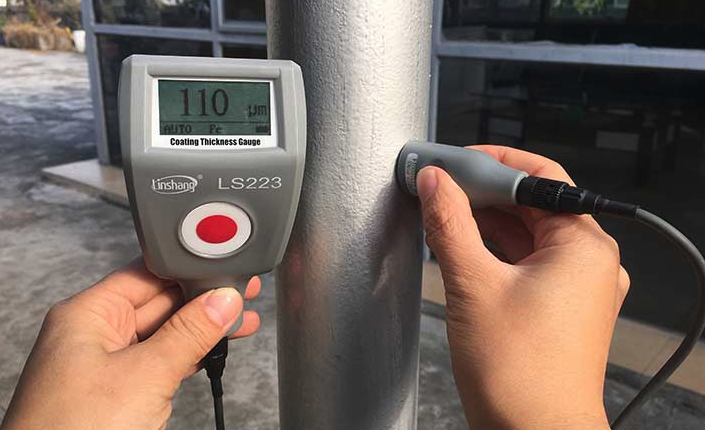
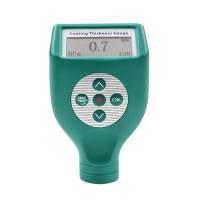
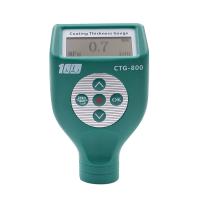
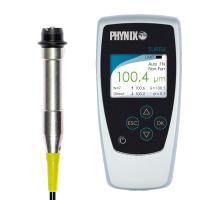
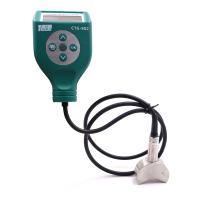
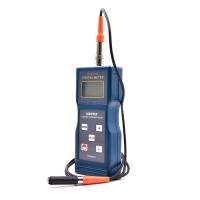
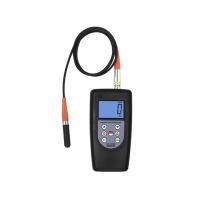
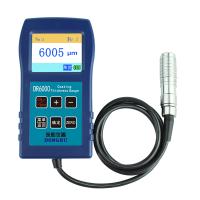
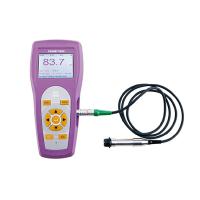
When measuring the fireproof coating thickness of steel pipes, Linshang LS223 paint thickness Tester can be used. This paint thickness Tester uses magnetic and eddy current thickness measurement principles. It adopts the separation design of probe and host. You can view measurement data while measuring. The compact design is easy to carry. The instrument can be used in laboratories and engineering fields. Linshang Paint Thickness Tester complies with the following standards:
"GB/T 4956-2003 Determination of Thickness of Nonmagnetic Coating on Magnetic Substrate - Magnetic Method"
"JJG-818-2005 Inspection Regulations for Magnetic Eddy Current Thickness Gauge"
"DIN EN ISO 2808 Determination of film thickness of paints and varnishes"
"GB/T 4957-2003 Non-magnetic base metals - Measurement of the thickness of non-conductive coatings by eddy current method"
For more coating Thickness Gauge products, enter: https://www.nbchao.com/list26/