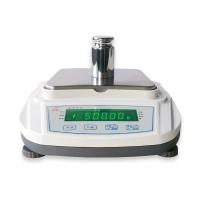
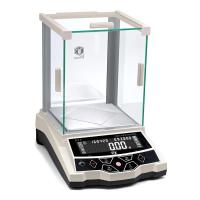
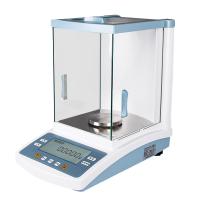
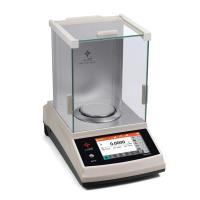
An analytical balance is one of the important pieces of equipment in any modern university laboratory. These sophisticated instruments can display the mass of a material to the nearest 0.0001 or 0.00001 gram. Students and researchers in fields such as materials analysis and drug testing require high-precision experiments. Analytical balances are equipped with transparent housings, since even the smallest dust or drafts can adversely affect the measurement.
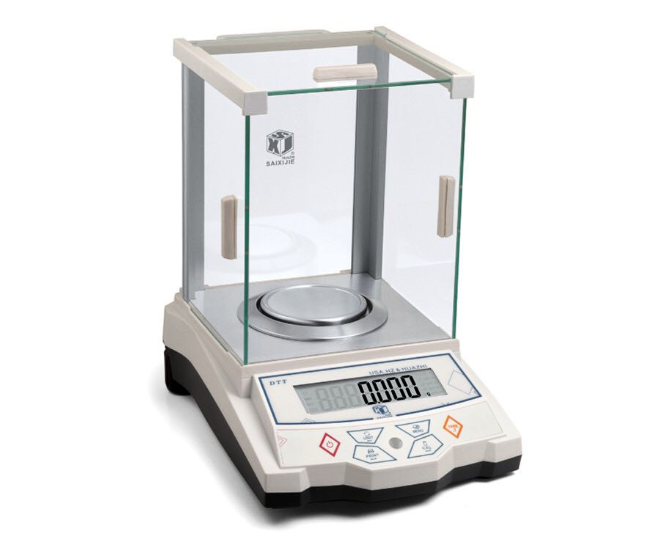
Analytical balances are so important to university laboratories that some facilities perform calibrations on a daily basis, ensuring their instruments provide accurate results. At UConn, a staff member coordinates the validation program for each balance used in advanced chemistry courses. The school's chemistry department also arranges for a technical company to conduct an annual inspection of each balance to ensure the accuracy of each instrument.
The Department also arranges an "Introductory Balance Lecture" to familiarize new students with the care and maintenance of analytical balances. As part of the introductory training, each student performs a simple experiment with a balance under the supervision of a lecturer or teaching assistant. Students who received the training and followed the procedures listed were assigned to perform laboratory work with the new digital analytical balance, while the balance not assigned the old data required more time per measurement.
At Dartmouth, the Department of Chemistry also details the use of analytical balances for introductory students. The school's website shows students how to check the stability of the weights displayed on the balance, how to place weighing paper on the weighing pan, and how to "tare" the scale. The taring process involves offsetting the weight of any container (such as weighing paper) before weighing the sample. All digital analytical balances feature an automatic tare function.
Due to the sensitivity of analytical balances, preliminary calibration work is required. Unless the conditions in the lab are the same as those on the factory floor (including gravity, humidity, barometric pressure, and temperature), readings "out of the box" will not be completely accurate. Many of the best models have an internal calibration mode in which the machine will measure a built-in weight and adjust itself to the laboratory's atmospheric conditions.
For some analytical balances, users can adjust environmental filter settings to allow the machine to respond to various conditions "for more controlled results." For example, if the balance is weighing an unstable item such as an animal, the filter can be set to the unstable condition; small changes in weight due to animal movement are filtered out, and a stable reading is obtained. The balance includes an RS232 interface which allows it to send data to a computer or printer. The instrument has an adjustable data transfer rate, allowing results to be transferred to other compatible data storage devices.