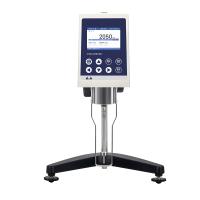
Rotational viscometers are widely used in ceramic production to measure the viscosity of ceramic glazes. Glaze is a liquid pasty substance, mainly composed of oxides, oxide mixtures, glass, etc., and its viscosity refers to the resistance of the glaze to flow at a specific temperature and shear rate. Viscosity is an important parameter in ceramic glaze, which is directly related to the fluidity, uniformity, adhesion and surface effect of the glaze.
The viscosity of ceramic glazes is usually measured during production processes such as glaze preparation, coating, decoration and firing. A Rotational Viscometer is an instrument that can measure the viscosity of a liquid at different shear rates. It measures the viscosity of a liquid by rotating a rotor or vane to create a shear force in the liquid.
In the production process of ceramic glaze, the Rotational Viscometer can determine the best coating process parameters and sintering temperature by measuring the viscosity of the glaze under different shear rates. By controlling the viscosity, the uniformity and surface quality of the glaze can be guaranteed, and the quality and market competitiveness of ceramic products can be improved.
In addition, the Rotational Viscometer can also help ceramic manufacturers to study the rheological properties and processing properties of new glazes, and provide technical support and guidance for the development and production of new products.

The specific steps to measure the viscosity of ceramic glaze are as follows:
Sample preparation: Take a certain amount of sample from the ceramic glaze and stir it evenly at an appropriate temperature to make it reach a stable state.
Calibrate the Rotational Viscometer: Calibrate and prepare the Rotational Viscometer according to the instrument manual. Calibration includes checking the stability, precision and accuracy of the instrument to ensure the reliability of the measurement results.
Measuring Viscosity: The rotor or vane of a Rotational Viscometer is immersed in the glaze and rotated at a certain shear rate. During the rotation process, the Rotational Viscometer will generate shear force, which will make the glaze flow and be subjected to certain resistance, and the viscosity value of the glaze can be obtained by measuring the resistance. Often multiple measurements at different shear rates are required to obtain more accurate results.
Data processing: process the measured data, calculate the viscosity value of the glaze, and analyze and compare. Shear rate and viscosity curves can be plotted as needed to present data more intuitively.
Interpretation and application of results: Based on the measurement results, the viscosity characteristics of the glaze are evaluated and corresponding adjustments and improvements are made. The viscosity of the glaze can be controlled by adjusting factors such as temperature, dilution and formula to achieve better coating effect and surface quality.