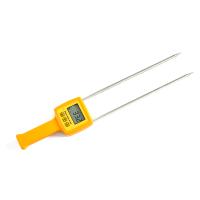
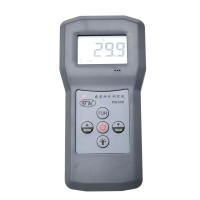
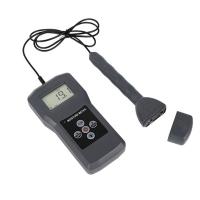
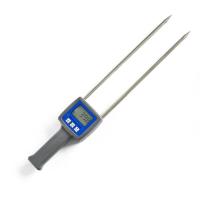
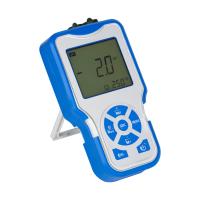
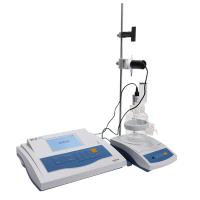
Before introducing the various moisture measurements, it is important to define moisture content. Moisture content is usually expressed as a weight percent of the total product (wet basis) or dry product (dry basis).
Moisture content on wet basis:
M = 100 x (wet weight - dry weight) / wet weight
Moisture content on dry basis:
M = 100 x (wet weight - dry weight) / dry weight
According to the above formula, the moisture content on a wet basis cannot exceed 100%. Moisture on a dry basis may exceed 100% and is a non-linear function. Moisture content can be determined by a variety of techniques. These can be broken down into two main categories, primary and secondary metrics.
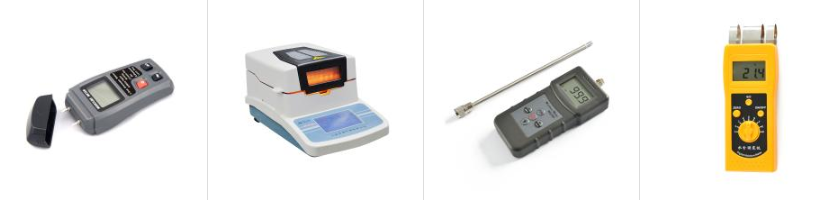
Primary moisture techniques typically extract moisture directly from the product and directly measure moisture content.
All major methods are destructive and time-consuming. The main method is performed offline, but is usually very accurate. Small sample sizes may not be adequately representative of bulk product.
A common primary method is loss in weight, where a sample is weighed, dried until no more weight loss is achieved, and then weighed again.
Other methods include Karl-Fischer titration. The accuracy of all offline primary methods depends on the accuracy of laboratory instruments and the skill of laboratory personnel.
As offline methods require product samples to be obtained from the process, sampling methods need to provide consistent product samples for testing.
Secondary moisture techniques measure a property (moisture) of a variable rather than the variable directly. All continuous moisture analyzers use a secondary measurement principle and need to be calibrated against a primary reference technique. They have the advantage of continuous or fast sampling measurements for real-time process monitoring and control.
Without continuous measurement capability, a typical process would be controlled by taking product samples and performing laboratory analysis. These methods are time consuming. By the time results are obtained, the process may have changed considerably.
In simple form, a continuous moisture analyzer will provide trending information between laboratory samples even without calibration. In this form, the instrument is a useful setpoint controller that adjusts the process setpoint after each laboratory sample is taken.
There are many online moisture measurement techniques. Dielectric measurements and NIR reflectance are two that have proven accurate and reliable in many industries.
1. Radio Frequency Dielectric Technology
This method relies on the high dielectric constant of water relative to most solids.
A number of techniques have been developed to determine dielectrics, including radio frequency, microwave, and time domain reflectometry. In order to measure the relative permittivity of a material, the material needs to be electrically coupled to a sensing circuit. This can be done by placing the material between two parallel electrodes, but this is not convenient for in-line applications. If the sensing circuit operates at radio frequency, it is easy to propagate the RF energy through the material, allowing it to couple to the product without physical contact. Planar fringe field electrodes provide a one-sided measurement structure with less impact on the process.
The electrical analog of a solid product is a capacitor in parallel with the leakage conductivity. These components are all affected by moisture, but the dielectric constant is very predictable while the dissipation factor is not. The combined component represents a complex impedance that can be easily measured, but it can be affected by variables other than humidity.
True dielectric Moisture Meters are rare because most low-cost instruments make no attempt to separate the dielectric and loss components. The lowest cost instruments make little or no attempt to measure combined impedance with any long-term stability and repeatability.
It is a penetrative measurement that can measure inhomogeneous products.
It has a larger measurement area to provide a more representative overall average moisture content of the product.
It is relatively inexpensive compared to other online technologies.
It's extremely reliable, solid, and has no moving parts to wear out or break.
Various mechanical sensor designs are suitable for various process conditions and can be used in high temperature environments.
2. Infrared technology
Near Infrared Reflectance (NIR or IR) technology is a widely used technique for in-line moisture testing. Much of its popularity is due to its ease of use.
A light source (usually a quartz halogen bulb) is collimated and filtered to specific wavelengths. Optical filters mounted on a rotating wheel chop the light into a series of pulses of specific wavelengths. The filtered light beam is directed onto the product surface to be measured. A portion of the light is reflected back to the Detector (usually lead sulfide). Specific wavelengths of light are absorbed by water. If the filters are chosen such that one wavelength will be absorbed by water (sample beam) and one wavelength will not be affected by water (reference beam), the ratio of the amplitudes of the two reflected wavelengths will be directly proportional to the amount of water in the water.
Easy to apply. Typically installed 6 to 10 inches above the product. Moderate product height variations have little effect on the measurement.
The small spot measurement area combined with the scan frame provides product contours.
Specific wavelengths can be selected to measure variables other than humidity.