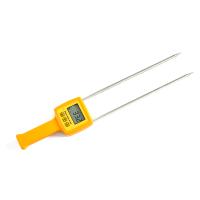
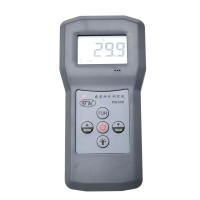
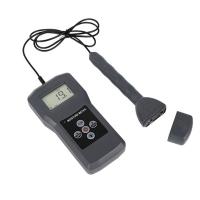
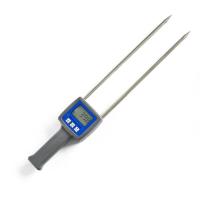
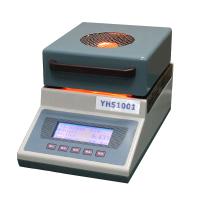
Near-infrared reflectance (NIR) technology uses near-infrared wavelengths to provide surface measurements of a product's moisture content. The evenly distributed moisture composition offers the opportunity for fast, easy and dynamic measurement of almost any product.
Infrared measurement
A simplified description of IR theory states that IR light is focused on the sample and specific wavelengths are absorbed by the analyte. This specific wavelength of reflected or transmitted light is related to the analyte concentration and is used as the basis for the IR measurement.
When infrared light reaches a sample, several interactions occur: the light is absorbed, reflected or transmitted. Transmitted light will pass through the product, backscattered light will reflect from the product, and some light will be absorbed by the product. Absorbance is the key to infrared measurements. The concentration of the analyte is related to the absorbance. Infrared instruments use reflectance or transmittance to determine absorbance.
A dull matte sample will give a diffuse reflection, whereas a shiny specular sample will give a specular reflection. These reflectance interactions are commonly used for measurements on solid samples. Most materials have both specular and diffuse components. Typical diffuse reflectors include matte paper, tobacco, and ceramic powders, while typical specular reflectors include glossy paper, foil, and plastic sheets.
Some light can be diffusely reflected through thin or transparent samples, to diffuse (translucent) samples, or directly transmitted through transparent samples. Liquid measurements typically use transmitted light.