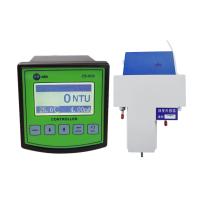
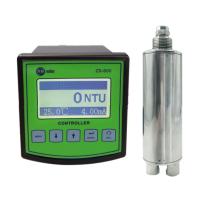
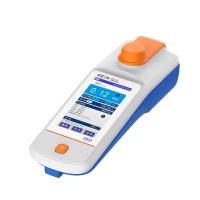
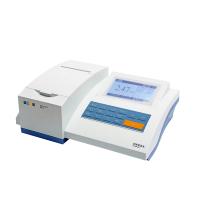
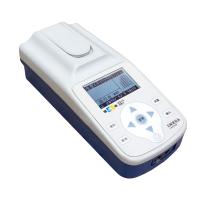
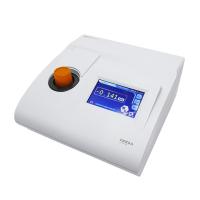
Turbidity measures the cloudiness/turbidity of a fluid. This is a key test of water quality, turbidity is caused by particles of varying sizes that scatter/absorb light and create a cloudy appearance. The turbidity of the sample will increase with the amount of undissolved solids present.

The easiest and least costly way to measure sample turbidity is a turbidity tube. This is a tube with a black cross on the bottom, the user simply pours water into the tube until they can no longer see the black cross, at which point you can read the scale on the outside of the tube in the NTU. Secchi disks work similarly, a colored disk mounted on a production line is slowly lowered into the water, when the disk is no longer visible, the lowered pipe length is measured and converted to NTU. As simple as these methods are, they cannot measure very low turbidity, are not very precise, and rely on the judgment of the user to be consistent.
For more accurate measurements a photometer is used which sends light of known intensity through the sample which is scattered/absorbed by the particles in the sample, thus this scattered light will be detected and measured to give the turbidity degree readings. These can be divided into two categories, as described in ISO 7027-1:2016 for the determination of turbidity in water quality:
1) Turbidimetry is used for water with low turbidity (<40 NTU), where scattered light is measured at a 90° angle;
2) Applicable turbidity For highly turbid water (500-1000 NTU), colored is measured at 180°.
Nephelometers emit white light or have an infrared light source. To comply with EPA method 180.1, you will need to use a tungsten gauge. For most other applications, an ISO specified design turbidimeter with an infrared light source can be used. An infrared light source can minimize or even eliminate the effect of coloration in the sample, whereas a white light source in a colored solution will be inaccurate. However, if your samples are mostly transparent, contain small particles and have low turbidity, IR sensitivity is low, in which case a white light meter should be used. This is because small particles tend to scatter less infrared wavelengths of light, but they are absorbed by white light.