What is conductivity?
Conductivity is the measure of a substance's ability to conduct an electric current through it. In water, many compounds and molecules, such as dissolved salts and inorganic materials, dissociate into constitutive ions. Ions are small subatomic particles that carry an electrical charge. Positive (cation) or negative (anion). These particles help conduct electrical charge through matter. The conductivity of water is directly related to the concentration of ions present, so more ions present means higher conductivity, and conversely, lower conductivity in purer water. It is worth noting that even if the amount of ions in the water sample increases (increased conductivity), the total charge will still be the same as the cations, while the anions will cancel each other out.
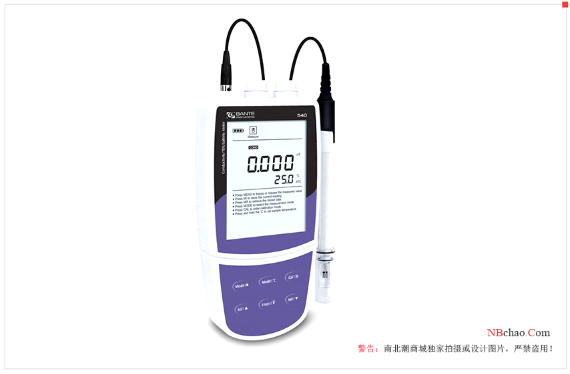
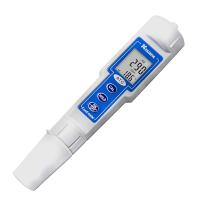
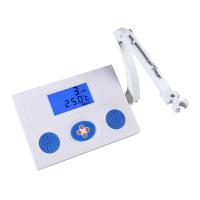
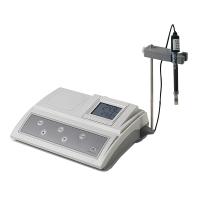
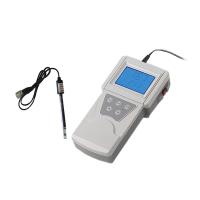
Conductivity can be used as a measure of dissolved salts and inorganic substances in a sample, and conductivity readings are used to report water quality in many industries, but can also be measured directly in soil. Overall can be an indicator of quality. Use a professional electrochemical meter-conductivity meter for readings. Often these meters also use pre-programmed conversion settings to measure a number of related parameters - resistivity, TDS and salinity.
Conductivity measurement unit
The unit of conductivity is S (Siemens)/m, but the unit μS/cm is also very commonly used. Other units of measurement include microohms or milliohms/cm. 1 Siemens (S) = 1 mho.
Relationship to other measurements
Resistivity is the inverse of conductivity (resistivity = 1/conductivity) and is a measure of the ability not to conduct (i.e. resist) electrical current. The unit of measurement is ohms/m (Ωm). Resistivity is often used to measure the quality of pure water.
TDS is a measure of the dissolved solids content of a water sample, i.e. a measurement of all particles larger than 2 microns in size, which includes dissolved salts as well as dissolved organic compounds such as hydrocarbons. This measurement can be derived from the conductivity reading using a conversion factor, which can be pre-programmed into some conductivity meters. The relationship between conductivity and TDS is not constant, but it is generally estimated to be a constant conversion factor of about 0.65 – this factor may need to be increased for water with high ionic content and decreased for pure water. Measurement units include g/L and ppt. The TDS of water affects the osmotic balance of organisms, so its monitoring is of great significance in wastewater and environmental monitoring.
Salinity is a measure of all dissolved salts in water. It is usually measured indirectly and is derived from the conductivity reading using a conversion factor that is usually preprogrammed into the conductivity meter. Typical units of measurement are PSU, % and ppt. Salinity affects dissolved oxygen levels in water. Industries that use salinity measurements include agriculture, hydroponics, aquaculture, and pools and spas.
Types of Conductivity Probes
Extra care needs to be taken when selecting the right conductivity meter and probe for your application. Below we list the two main conductivity probes available and the applications/sample types they are suitable for. Factors to consider when selecting include: expected conductivity range, sample volume, and sample composition (acidic, viscous, dirty, etc.). Conductivity probe bodies can be made from a variety of materials, so you will need to make sure the body type is right for your sample type.
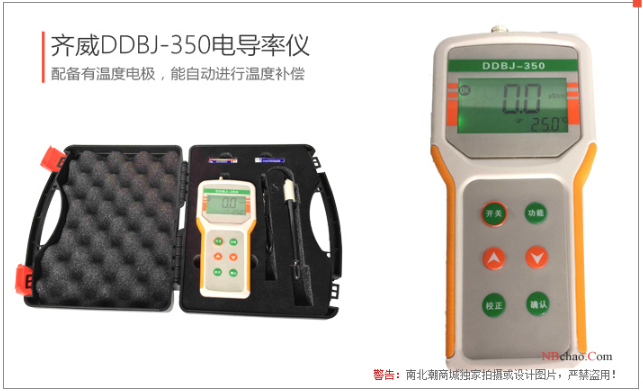
Amperometric probes work by applying a known voltage between two internal electrodes. Then measure the current. The electrodes themselves can be made of graphite or steel. This type of probe is suitable for clean water applications due to possible mineral deposits and polarization at high conductivity. Such probes tend to be more affordable than potentiometric probes and require only a small amount of sample. An example of this probe type can be found here.
A potentiometric probe consists of four rings. They work by applying a voltage to the two outer rings to induce a current. This drives an electric current in solution, which is measured between the two inner rings. The voltage drop will depend on the conductivity of the sample. These probes offer high accuracy, high accuracy and a large application range due to their ability to be used at higher conductivity values. They are suitable for most applications. However, these probes require larger samples because the ventilation holes need to be covered. An example of this probe type can be found here.