Why is salt contamination measurement important?
The presence of soluble salts has been shown to have a significant negative impact on coating performance and lead to premature failure of the coating. Salt remaining under the protective coating creates a penetrating force that draws moisture from the atmosphere through the coating. The pressure created by the water beneath the coating overcomes the adhesive bond between the coating and the substrate, leading to corrosion, osmotic blistering and eventual coating failure. Therefore, the importance cannot be overemphasized to ensure that the substrate is free from soluble salt contamination prior to spraying.
What does the PosiTector SST Salt Tester measure?
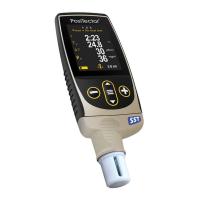
PosiTector SST includes a certified and traceable conductivity probe designed for ISO 8502-6,9. A "Certificate of Calibration, Long Form" is supplied with each probe. The following parameters are measured by PosiTector SST:
Conductivity (µS/cm)
Sampling temperature (C° or F°) normalized to 25°C
testing time
Using the measured conductivity value and the sample test volume (set in the gage menu), automatically calculates the apparent density of the salt (mg/m2 or µg/cm2) according to ISO 8502-9, saving the gage operator time and money . Eliminates the chance of calculation errors.
What are the typical applications?
PosiTector SST is ideal for:
(a) Test substrates for the presence of soluble salts according to ISO 8502-6,9 (Bresle method)
(b) Testing of explosive media according to ASTM 4940 and ISO 11127-6 (Determination of water-soluble contaminants in abrasives by conductivity measurement)
(c) Test the conductivity of water in the range of 0-500 µS/cm
How is the PosiTector SST conductivity probe different from the regular conductivity meters that come with most other test kits?
PosiTector SST conductivity probes are specially designed for ISO 8502-6,9 and have many features not found in conventional conductivity meters, incl. . .
On-screen user interface simplifies the task by guiding the user through the Bresle test method
Track and report test duration (total contact time between solvent and substrate) as required by ISO 8502-6
Automatic calculation of surface density by adjusting for different patch volumes – works with any Bresle type patch
Free software for viewing and reporting data
A long-form certificate of calibration traceable to NIST is included at no additional charge. The supplied conductivity standards (calibration solutions) are also supplied with a certificate.
25°C temperature automatic normalization
Record sample temperature according to ISO 8502-9 requirements
Dedicated 1 ml test cell optimized for Bresle method range, resolution and test volume
Robust stainless steel electrodes – ideal for industrial environments
What information does the PosiTector SST Soluble Salt Meter keep in its memory for each test?
PosiTector SST saves all measurement information for each test. All information is also reported in the PosiSoft software.
Test date and time
Test time (total contact time between solvent and substrate)
Background sample temperature (°C or °F)
Final sample temperature (°C or °F)
Conductivity increase (µS/cm) between background and final sample
Calculated surface density of soluble salts (mg NaCl/m2, mg CL/m2, µg NaCl/cm2 or µg Cl/cm2)
Does your instrument require any formal training to use? Do you offer "demo" models?
Won't. Our instruments are designed for simple operation, with easy-to-use menus, full and quick instruction manuals, and helpful videos. In lieu of a demo model, we offer unlimited technical support by phone and/or email with a limited 30-day money-back guarantee.
Does the PosiTector SST need to be calibrated before use?
The PosiTector SST is now fully calibrated and ready for measurement. Comes with a long-term certificate of calibration traceable to NIST or PTB, documenting the actual readings your instrument took in our calibration laboratory against standards traceable to national metrology institutes. Beware of "certificates" or "certificates of conformity" offered by competitors. These usually do not include actual instrument readings and are often insufficient for common quality requirements.
Users can perform accuracy verification by measuring a known reference standard, such as the supplied conductivity standard.
Can the PosiTector SST measure the concentration of individual salt ions?
The PosiTector SST measures the total conductivity of the test solution and converts this value to the total surface density of the salt using the calculation method specified in ISO 8502-9.
Does the PosiTector SST display readings in PPM of salt?
PosiTector SST was built specifically for the Bresle test method and cannot solve PPM calculations. While there are empirical conversion factors for converting PPM to surface density, these conversion factors are not recognized by any test method.
Can PosiTector SST probes be submerged in the fluid being tested?
yes. The PosiTector SST is an excellent choice for testing the conductivity of water in the range 0-500 µS/cm by immersion only in the test cell.
Can PosiTector SST be used to measure salt concentration in explosive media?
yes. The PosiTector SST can be used as a conventional conductivity meter, making it ideal for testing abrasives according to ISO 11127-6 and ASTM D4940-15.
How often should PosiTector probes be recalibrated?
PosiTector probes include a Certificate of Calibration showing each probe's traceability to NIST or PTB (long form) - no expiration or expiration dates. They have no shelf life, so the length of time in the field is not a good indicator of recalibration intervals. Many organizations with quality programs and recertification programs require annual recalibration, which is a good starting point for most users. DeFelsko recommends that customers determine calibration intervals based on their own experience and work environment. Based on our product knowledge, data and customer feedback, a one-year calibration interval from the date the instrument is placed into service is a good starting point.