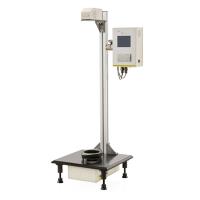
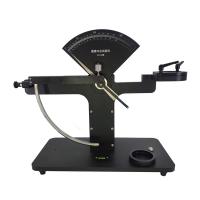
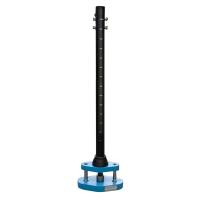
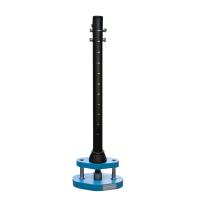
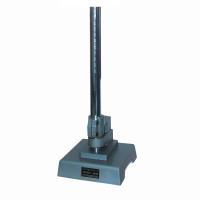
The impact test is the ability of the paint film to withstand rapid deformation without cracking. A heavy object falls along the conduit onto the hemispherical to deform the sample plate. Below the template, there is a recessed hole seat facing the indenter. Gradually raise the weight until the paint film cracks. If the paint film is directly impacted by the pressure head upward, it is called positive impact. The downward direction of the paint film is called recoil. Recoil is more severe than thrust because recoil is extension and thrust is compression. Almost any paint film will pass through . Small surface differences of the same type and different batches of bottom plates will also affect the test results. Film thickness, substrate thickness, and surface preparation all affect impact strength results and require standardization.
Impact strength shows the flexibility of the paint film and its adhesion to the substrate. Impact resistance is actually a rapid deformation caused by an impact load. It is different from the impact performance of the paint film under static load. The latter is also affected by plasticity and time. However, this problem does not exist in the case of impact load, so ISO 6272-1993 was renamed drop weight test.

The instrument used for impact resistance is an impact Tester. A heavy hammer of a certain mass is dropped on the coating film sample plate to make the coating film undergo elongation and deformation without causing damage . Impact resistance, usually expressed in N cm (kgf cm ). The maximum value of commonly used instruments is 18.08N · m.
The shape of impact Testers commonly used in various countries is basically the same, but there are different specifications . CHINA's national standard GB 1732-79 (88) "Determination of Impact Resistance of Paint Film" stipulates that the weight of the hammer is 1000g ± 1g, the depth of the punch entering the groove is 2.0mm ± 0.1mm, and the scale of the sliding cylinder is equal to 50.0cm ± 0.1cm. The division is 1cm. Now there is a variable impact Tester, the scale of the sliding cylinder is increased to 120cm, and the weight and punch have various specifications, which can be replaced according to different standards .
Paint films are generally used in the glassy region. In the impact test, the deformation speed of the paint film is very large, and the stress relaxation speed is the key to pass the impact strength test. The secondary transition temperature (β peak) located in the glassy state region is the starting temperature of the local main chain and side group movement . The lower the temperature of the 3 peak, the greater the relaxation speed after being impacted. However, the deformation caused by the impact is a relatively large chain movement, which does not occur in the glassy region. Another explanation is that: the secondary transition temperature in the dynamic mechanical spectrum is measured at low frequency deformation (the resolution becomes poor at high frequency), and the impact frequency is extremely high. According to the time-temperature equivalent, that is to move to the high temperature side. The movement of the main chain may be excited at the impact rate, thereby driving a large degree of chain movement.
In practice, the secondary transition (β peak) temperature is very closely related to impact strength. The impact test is very sensitive to the integrity of the paint film, so it can also determine the degree of coalescence of the water-dispersed coating to form a film.