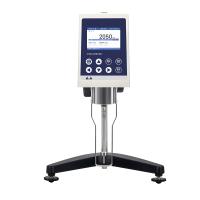
The basic principle of measuring viscosity with Rotational Viscometer
The basic principle of the Rotational Viscometer to measure the viscosity is based on the rotation of objects immersed in the fluid (such as cylinders, cones, discs, balls and other rigid bodies), or when these objects are stationary and the surrounding fluid rotates, These objects will be affected by the viscous moment of the fluid. The magnitude of the viscous moment is proportional to the viscosity of the fluid. The viscosity can be obtained by measuring the viscous moment and the rotational speed of the rotating body.

Basic steps to verify Rotational Viscometer
(1) Adjust the level of the viscometer, and then the viscometer is automatically zeroed or the zero point is idling after the rotating cylinder is installed (the latter is for the pointer viscometer , so that the zero point can be deducted during the actual measurement).
(2) Pour a certain volume of standard solution of known viscosity into a container of specified volume , immerse the clean rotating cylinder in the standard solution to the mark line, then keep the rotating cylinder and standard solution at the test temperature at the same time, and eliminate bubbles .
(3) Repeated measurement of deflection angle (repeated measurement of viscosity should be performed ) and parallel measurement.
(4) Calculate the viscometer constant or read out the viscosity value, and compare the result with the verification regulations or the viscosity value of the standard liquid to determine whether the viscometer is qualified.