The thickness of the pressure-sensitive adhesive layer has a great relationship with the performance of the pressure-sensitive adhesive product. The following introduces how to test the thickness of the pressure-sensitive adhesive product.
The sum of the thickness of the substrate and the thickness of the pressure-sensitive adhesive layer is the thickness of the pressure-sensitive adhesive product. The three pressure-sensitive adhesive properties of pressure-sensitive adhesive products all have a great relationship with the thickness of the pressure-sensitive adhesive layer, while the tensile strength, electrical insulation performance and flame resistance of pressure-sensitive adhesive products mainly depend on the properties of the substrate and thickness. Therefore, it is very important to measure the thickness of pressure-sensitive adhesive layer and pressure-sensitive adhesive products.

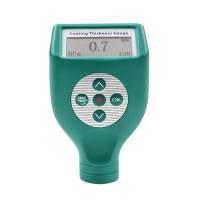
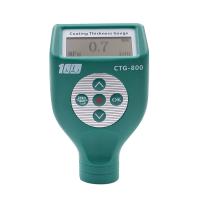
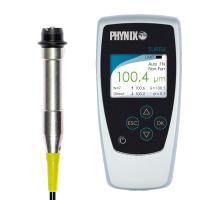
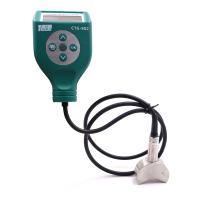
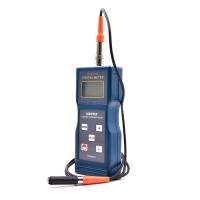
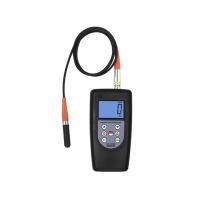
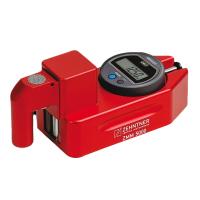
The thickness of pressure-sensitive adhesive products and the thickness of the substrate can be directly measured with various Thickness Gauges. Commonly used Thickness Gauges are mechanical and eddy current, both of which are composed of two parallel probes that can move up and down and a system that controls the distance and contact pressure between the two probes. When measuring, after peeling off the anti-adhesive layer of the sheet pressure-sensitive adhesive product and the outermost 3~5 layers of the roll-shaped tape, gently place the base surface of the fresh and clean pressure-sensitive adhesive product on the lower probe surface, and then Lower the upper probe slowly to make it contact with the pressure-sensitive adhesive surface, adjust the contact pressure to the specified value, and read the distance between the two probe surfaces. Generally, after repeated measurement at different parts for 3~10 times, the arithmetic mean value is taken as the thickness value of the pressure-sensitive adhesive product, and the unit is um.
The type of Thickness Gauge, the accuracy of the measurement system, the diameter of the probe, and the pressure per unit area during measurement have a great influence on the measurement results of the thickness of pressure-sensitive adhesive products. Therefore, all countries have made corresponding regulations on these when formulating corresponding national standard test methods or industry standard test methods. CHINA National Standard GB 7125-86 "About Determination of Pressure-Sensitive Adhesive Tape Thickness-Eddy Current Method" stipulates: use eddy current Thickness Gauge; measurement accuracy is 1.0μm: measurement error is ±1.0μm, reading value error is ± 2%; the probe diameter is (5±0.05)mm; the pressure is (40±3)kPa

The thickness of the substrate can be measured by the same method as above, using the substrate without the pressure-sensitive adhesive as the sample or the substrate after the pressure-sensitive adhesive layer of the pressure-sensitive adhesive product is carefully and cleanly removed as the sample. The diameter of the probe and the pressure applied during the test have little effect on the measured results of the substrate thickness.
The thickness of the pressure-sensitive adhesive layer is generally not directly measured, but calculated by subtracting the thickness of the substrate from the thickness of the pressure-sensitive adhesive product.
In the Chinese mainland, although the original national standard GB 7125-86 stipulates the use of eddy current Thickness Gauges, in fact most manufacturers use various mechanical Thickness Gauges to measure the thickness of pressure-sensitive adhesive products and substrates. In order to prevent the pressure-sensitive adhesive layer from contaminating the measuring probe, some manufacturers evenly paste the adhesive surface of the pressure-sensitive adhesive product together, then measure the thickness of the two-layer product, divide the measurement result by 2 and subtract the thickness of the substrate to obtain the adhesive layer thickness of. These measurement methods can quickly measure the thickness of the glue layer on the gluing production line, so as to adjust the amount of glue in time. However, with these online measurement methods of mechanical Thickness Gauges, the measurement accuracy is generally poor.