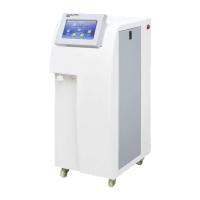
During the use of the ultrapure water machine, the basic maintenance work is daily maintenance and replacement of consumables. But once the equipment fails or even affects the work progress, many users will be helpless. Let's take a look at the troubleshooting of the laboratory ultrapure water machine below in order to use the equipment more effectively.
1. The device does not emit water
①Equipment failures are generally divided into waterway failures and circuit failures;
②If the equipment does not produce water, it may be a waterway failure. You may wish to check whether there is any blockage in each pipeline;
③ It may also be a circuit failure, check whether the input power supply is normal and whether the water inlet solenoid valve is normal;
④ Open the source water ball valve, check whether the filter element before the RO membrane is blocked, and replace it in time if it is blocked;
⑤ Check the pressure after the booster pump, if it is lower than 0.3MPa, it needs to be replaced.
2. After the water storage tank is full, the booster pump starts repeatedly
①Insufficient source water pressure;
② If the check valve is damaged, just replace it in time;
③High voltage switch failure;
④The pipeline is loose and leaking, and the pressure needs to be released.
3. Excessive noise during operation
① Check whether the source water pipeline is normal and whether there is any water cut-off phenomenon. Once the water is cut off, the booster pump will run idly, resulting in excessive noise;
②If the source water is supplied normally, then check whether there is gas in the source water;
③ Check whether the booster pump vibrates too much or fails;
④ Check whether the equipment is placed stably and whether the compressor is abnormal.

4. The ratio of pure water to wastewater is seriously out of balance
① Check whether the flushing solenoid valve is damaged;
② Check whether the RO membrane is blocked;
③ Check whether the waste water proportioner is blocked. If it is blocked, too much pure water will be produced and too little waste water will be discharged.
It must be mentioned that, in addition to the above-mentioned faults, there is also a type of "false fault" that is difficult to quickly troubleshoot. Once a user replaced the RO membrane, the quality of the effluent water became worse and worse. The preliminary judgment may be that the RO membrane is broken or not installed properly. After the on-site inspection by the technical engineer, it was discovered that there was a problem of poor water discharge from the waste water drainage pipe. It turned out that the user accidentally pressed the waste water drain pipe when moving the device, which led to a continuous decline in the quality of the effluent.
Another user reported that the device buttons failed. This is obviously a circuit failure, and the immediate solution is to replace it. After the engineer inspected it, he found that there was a lot of water accumulated between the screen and the case. After careful understanding, I realized that a staff member put the water glass on the equipment, and it happened to be knocked down again. After wiping and drying, the device returned to normal.
The troubleshooting of the method of using the ultrapure water machine in the laboratory is shared here. After a fault occurs, we need to analyze where the variables are, and what changes have taken place in waterways, circuits, and the environment. After figuring out these situations, the fault problem can be solved in a targeted manner.