Optical adhesives such as fir glue, methanol glue, epoxy glue, organic silica gel and α-cyanoacrylate glue, etc., are used to bond optical parts, and the light transmittance within the specified wavelength range needs to be tested , can be used after reaching a certain index. Such as DG-4 optical adhesive, the transmittance of the adhesive layer in the specified wavelength range after curing is not less than 95%. This method is in accordance with GB 2410 89 "Test Method for Light Transmittance and Haze of Transparent Plastics".
1. Principle
The light transmittance T i is expressed as a percentage of the ratio of the luminous flux T 2 passing through the adhesive layer to the incident luminous flux T 1 .
T i = T 2 / T 1 ×100%
It mainly tests the transmittance of visible light wavelength 0.4~0.7μm, near infrared wavelength 0.9~1.2 μm , wavelength 3~5 μm or 8~ 12 μm infrared region.

2. Instrument
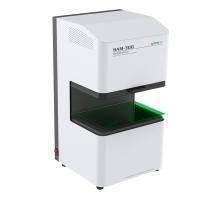
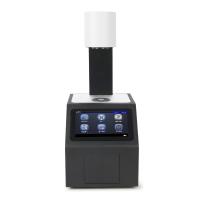
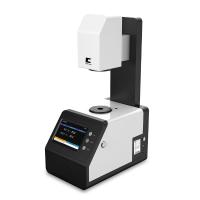
(1) Integrating sphere haze meter C light source;
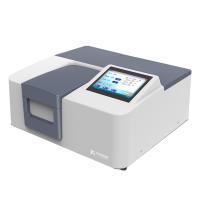
(2) Infrared Spectrophotometer 400~4000cm -1 .
3. Test steps
(1) Use sodium chloride crystal as the adherend to make a sample for testing light transmittance. The diameter of the test piece is 25mm, and the thickness is 5mm. Because the crystal refractive index of sodium chloride is 1.54, it is transparent in a wide wavelength range (0.2~15 μm ), so it is suitable for adhesive transparency samples .
(2) Spread the adhesive on the joint surface of two pieces of sodium chloride crystal glue, and then clamp it with a special clamp to ensure that the sample . Care should be taken during the bonding process to prevent surface contamination and moisture absorption of the NaCl wafer. The glued samples were placed in a silica gel desiccator for curing.
Then carry out the light transmittance test on the glued sample according to the instrument operation manual.

4. Results evaluation
Usually 5 samples are taken, and the arithmetic mean of the test results of not less than 3 samples is taken as the test result, and the effective number is taken to one decimal place
5. Influencing factors
(1) Spectral wavelength
Different wavelengths of light have different light transmittance, and the results are shown in the table.
| Light wavelength nm | 410 | 460 | 500 | 560 | 600 |
| Transmittance% | 93.8 | 97.0 | 97.5 | 98.0 | 98.5 |
Table 1 Effect of light wave wavelength on light transmittance of transparent organic silica gel
(2) Surface state of sample
The surface of the sample should be flat and smooth without scratches, pollution and other defects.
(3) Adhesive layer thickness
As the thickness of the adhesive layer increases, the light transmittance decreases. This is due . Therefore, the results of adhesive layer samples with different thicknesses are not easy to compare.
(4) The instrument should be checked regularly, and the operation should be strict and careful.