Seaplanes, carrier-based aircraft, aircraft flying in coastal areas, and other products have been corroded by sea and coastal salt spray for a long time, resulting in reduced strength of adhesive joints. Like the seawater immersion test, the main function of salt spray is to accelerate the electrochemical corrosion of the adhered material metal. Therefore, this test is mainly to test how much the corrosion of the metal to be glued has on the strength of the glued joint. The general process is that when the particles of salt mist settle on the adhesive joint, they quickly dissolve with the water droplets in the humid air or the aqueous solution of chloride or the dissociated chloride ions. Like water molecules, they all have high permeability , can penetrate into the interior of the adhesive, and reach the interface between the adhesive and the adhered material, causing the aging of the adhesive and the corrosion of the adhered material. In terms of fire and gas aging, for sea and coastal areas, because the atmosphere is full of salt spray, the corrosion of the metal material substrate by salt spray is an important reason for the aging of adhesive joints in these areas. The quality of this corrosion has a lot to do with the type of adhesive and the material of the metal to be bonded. It can be considered that the adhesive that can form more chemical bonds with the adhered metal has a certain protective effect on the corrosion of the metal surface.
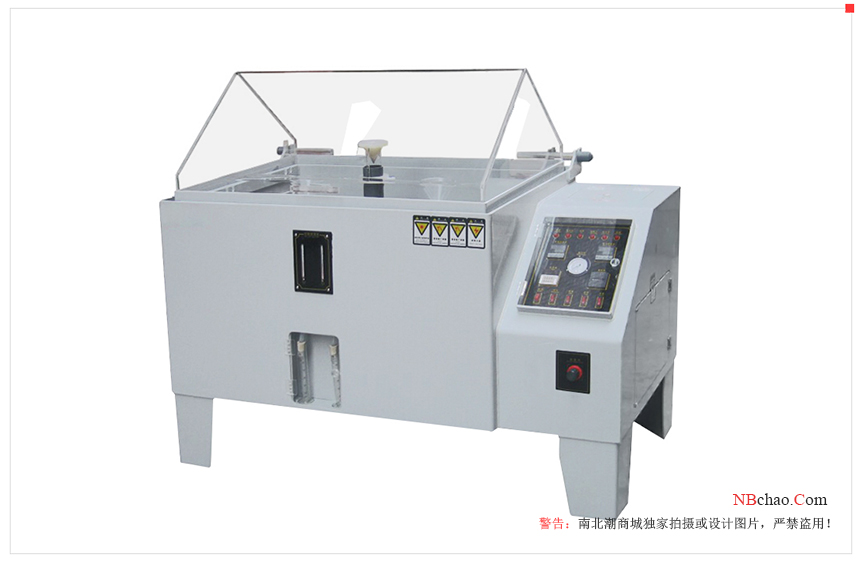
The salt spray Test Chamber adopts the JB1774 standard and should meet the following requirements.
The operating environment temperature is 5~35°C, and the adjustable range is 35~45°C. After the temperature in the box reaches the control value, in the effective test space, it corresponds to the standard digging value. The temperature uniformity is ±2°C, and the indicated temperature The fluctuation is ±1°C. The temperature inside the box should rise from 5°C to 45°C within 4 hours under full load. The spraying method is continuous spraying for 8 hours, then stop heating, stop spraying, and keep the average sedimentation rate of salt mist in the effective test space in a static state of 1~2ml/ (80cm3 h), the salt mist should settle freely, no forced landing. The brine in the Test Chamber is not allowed to be reused except for the part blocked by the fog baffle. The condensed water in the box shall not drip on the test specimens, and the solution flowing down from each specimen shall not fall on another specimen. The Test Chamber should be tightly sealed and the salt mist is not allowed to escape. The Test Chamber should be equipped with temperature indicator, lighting device, observation window and settling device for observing salt spray, and equipped with over-temperature and other safety protection and alarm devices, and equipped with an automatic salt solution replenisher for salt spray. There should be a sample holder for hanging samples, and any material that is in direct contact with the salt spray should not affect the corrosion of the salt spray.

If the method of producing salt spray in the salt spray Test Chamber is compressed air spraying, the compressed air needs to be degreased, dedusted, and preheated and humidified. The test box should be equipped with an air outlet to balance the internal pressure of the test box when spraying. A salt mist filter should be installed outside the air outlet to prevent the salt mist from spraying directly out of the box.
In addition to the above continuous spraying method, some domestic units also adopt the method of spraying pressure of 0.07~0.08MPa, test temperature of 35°C, spraying once every 0.5h, and spraying for 0.5h each time.
The spray volume can be calculated by the following formula
S=(G 2 -G 1 )/t
In the formula , G—the mass of the triangular bottle before collecting fog, g
t——fog collection time, h;
S - Settling amount of fog collection, g.
If the settling fog droplets are collected by a Φ100mm glass funnel with a loading surface of 80cm 2 , the unit of the settling amount is / (80cm 2 ·h).
