problem background
The following passage is excerpted from a viscometer standard:
Take an appropriate amount of the test solution, put it in a coaxial cylinder Rotational Viscometer with an inner cylinder diameter of 25mm and an outer cylinder diameter of 27mm, the inner cylinder is immersed in the sample to a depth of 42mm, and the sample is immersed at a speed of 18 revolutions per minute or 1.885rad s1 Angular velocity (or select appropriate measurement conditions, so that the shear rate is 24s-1), measured according to the law [general rule 0633 third method (1), the dynamic viscosity at 25 ℃ should not be less than 0. 6Pa s.
What is mentioned in the standard is not " Rotational Viscometer " , but "coaxial cylinder Rotational Viscometer " ! So what is a coaxial cylinder Rotational Viscometer? How is it different from ordinary rotor Rotational Viscometer?
Professional technical solutions
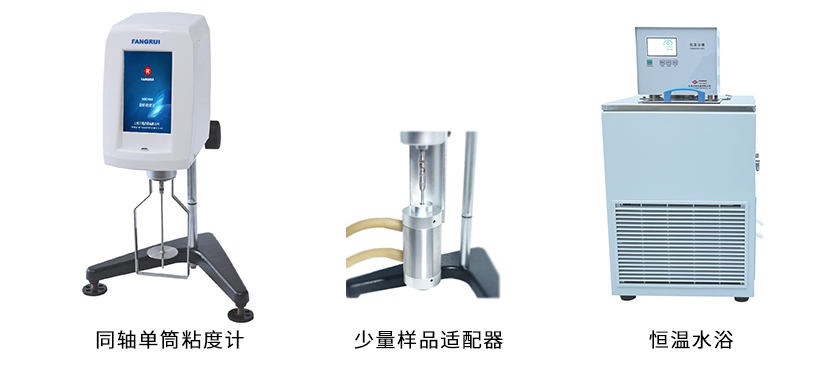
The coaxial cylinder Rotational Viscometer is also a rotor Rotational Viscometer. Conventional rotor Rotational Viscometer, we call it "coaxial single cylinder Rotational Viscometer", it is a rotor extending into the material to directly measure the viscosity.
The coaxial cylinder viscometer adds a set of accessories on the basis of the standard configuration of the ordinary viscometer. This accessory is generally a small amount of sample adapter or an ultra-low viscosity adapter, so this set is called a coaxial cylinder Rotational Viscometer. , is actually a coaxial double cylinder Rotational Viscometer.
question extension
After understanding what is a coaxial cylinder Rotational Viscometer, how to configure a complete set of viscometers according to the experimental tests mentioned in the standard?
First, choose a laboratory Rotational Viscometer that meets the viscosity test range;
Second, add a small set of adapters under the standard accessories of the viscometer, so that the measurement conditions of the coaxial cylindrical viscometer can be achieved, and the shear rate can be set to 24s-1.
Third, it is mentioned in the standard that " the dynamic viscosity at 25°C should not be less than 0.6Pa·s ", indicating that the laboratory test has temperature requirements. In general, a constant temperature Water Bath is required to meet the requirements of the whole set. testing needs.