Simply put, the critical pigment volume concentration (Critical Pigmentvolume Concentration) can be defined as: the pigment content in the dry ink (paint) film (the degree of pigmentation in the dry film). The gaps between the pigment particles in this ink film are just filled with enough binders.
Now, the concept of critical pigment volume concentration is often used as a kind of "concentration". In the case of this concentration, many properties of the ink (paint) film can cause unexpected changes. It can be imagined that at this concentration, the pigments are very closely attached to each other, but the gaps between them are still filled by the binder. Since the pigment particles are not spherical, but rod-shaped and needle-shaped, and may also be arranged in a row due to grinding, the degree of their bonding varies greatly. These conditions show that due to the difference of the link material and the difference of the extraction solvent, the results are also different.
(1) Appliances and materials.
1. Utensils
(1) 1/1000 balance.
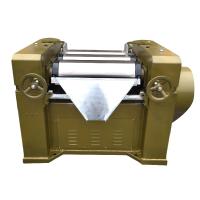
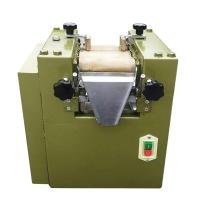
(2) Small three-stage machine.
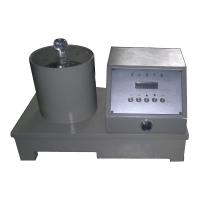
(3) Small centrifuge (with 100ml test tube).
(4) Glass filter pot (G4).
2. Materials
(1) Adjust the oil (600oc.P./20℃, equivalent to No. 3 oil).
(2) White Spirit.
(3) Mercury.

(2) Method.
The pigments and varnishes are rolled into a paste (containing 35% pigments) with a three-roll mill.
Weigh 8 grams of pigment slurry, put it in a glass test tube of a centrifuge, add 50 ml of petroleum solvent to dilute it, and centrifuge at 3000 rpm for 10 minutes to separate it. Pour off the clear liquid. Then add 50 ml of petroleum solvent to dilute it, then centrifuge, separate, and pour off the transparent liquid. Dilute for the third time as above, and after centrifugation, filter it with 4 glass filters and wash twice with petroleum solvent. Then add mercury to the predetermined scale of the Guochi Po pot (can be set arbitrarily). The critical pigment volume concentration (CPvc) can be calculated from the volume occupied by the Japanese medium and the volume of mercury used;
cpvc = V p ×100/(V c -V Hg )
In the formula. V p = weight of pigment slurry × pigment % in pigment slurry / specific gravity of pigment × 100% = 8 × 35/d × 100 = true volume of pigment.
V C = the volume occupied by the crucible.
V Hg = volume of mercury.
V c -V Hg = volume of filter cake.

(3) Matters needing attention.
1. Aromatic hydrocarbons (such as benzene) cannot be used for extraction, because they are mostly soluble to pigments.
2. Mercury can be quantified in a fine graduated cylinder first.
3. The critical pigment volume concentration is widely used in the coating industry because it is related to the characteristics of the coating film.
4. Critical pigment volume concentration (GpVC) refers to the pigment volume concentration (PVC) when many characteristics of the pigment-containing system (such as brightness, opacity, porosity, etc.) change.
Theoretically, it should be the case that a certain amount of binder just becomes insufficient to completely fill the space of the pigment particle, in its most compact form. Therefore, it seems that there is only one critical pigment volume concentration for each pigment, but in fact the value is different according to the different measurement methods. This is because: Due to the particle size, shape and particle size distribution (cloth), the wettability of the binder, the adsorption of the pigment surface and the dispersion method, the obtained compactness is also different.