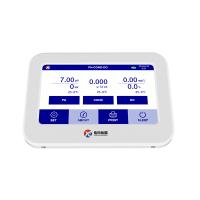
Conductivity is an important measure of water quality widely used throughout industrial process control. Applications for conductivity measurement include boiler water treatment, cooling tower water treatment and reverse osmosis monitoring.
There are several different types of sensors that can be used to measure conductivity. Choosing the right sensor for your application will improve accuracy and ensure the longevity of your equipment. An important factor to understand before choosing a conductivity sensor is how to choose a conductivity cell constant.
How Conductivity Sensors Work
Conductivity can be measured using contacting conductivity sensors or electrodeless toroidal conductivity sensors. The working principle of a conductivity sensor depends on the type of sensor. Knowing the conductivity cell constant is important when selecting a contacting conductivity sensor due to its operating principle.
A contacting conductivity cell has two or more surfaces of known area separated by a known distance from each other. The electrodes in a conductivity cell are constructed of conductive materials such as graphite, stainless steel, or platinum. Apply an AC voltage waveform across the cells and measure the resulting current. Conductive ions such as salts and metals provide paths for the flow of electricity. Therefore, high conductivity indicates high ion concentration.
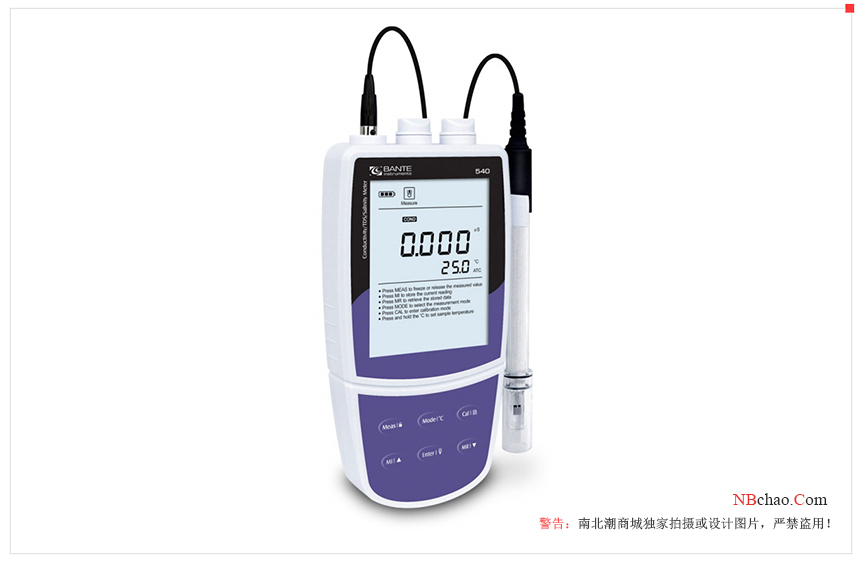
Specific conductivity and cell constant
Conductivity is usually measured in millisiemens (mS) or microsiemens (µS). When using a contacting conductivity sensor, the geometry of the conductivity cell can affect the conductivity reading. To ensure standardization of conductivity measurements, specific conductivity units are used. Specific conductivity is expressed as millisiemens per centimeter (mS/cm) or microsiemens per centimeter (µS/cm).
What is the conductivity cell constant?
Specific conductivity compensates for variations in conductivity cell geometry by multiplying the measured conductivity by a factor called the cell constant. The cell constant (k) is proportional to the distance between two conducting plates and inversely proportional to their surface area.
K = L/a, where a (area) = AxB.
Specific conductivity = measured conductivity (G) * cell constant (k)
Conductivity Cell Constant Determination
When the cell constant is 1.0, the measured conductivity (G) is approximately equal to the specific conductivity of the solution. However, the cell constant 1.0 is not always an appropriate choice. For example, in very low conductivity solutions, the measurement surface needs to be placed close together in order to generate a good signal to the conductivity meter. When the path length between the conductive plates is reduced, the cell constant is also reduced to 0.1 or even 0.01. Conversely, a longer path length (higher cell constant) of 10 or 100 will generally yield more accurate readings when measuring high conductivity solutions.
Choose a conductivity sensor with a cell constant appropriate for the conductivity range of the solution you want to measure. The table below lists the range of conductivity for typical solutions and the appropriate cell constant for each solution.
| Conductivity range | suitable cell constant | |
| ultra pure water | 0.05μS/cm | 0.01 |
| power plant or boiler water | 0.05-1μS/cm | 0.01 or 0.1 |
| drinking water | 150-800μS/cm | 1.0 |
| cooling tower water | 0-5mS/cm | 1.0 |
| waste water disposal | 0.9-9mS/cm | 1.0 |
| seawater | 53mS/cm | 10 (considering ring measurements) |
| 29% nitric acid | 865mS/cm | 100 (consider ring measurements) |