How to understand the minimum film forming temperature of emulsion?
As the name implies, the minimum film-forming temperature (MFT) of the emulsion is the lowest temperature that can ensure that the emulsion. The polymer forms a crack-free, continuous, transparent film. Forming a film at a temperature will result in an opaque, cracked film that has no mechanical strength and is easily smeared into chips or powder, making it useless.
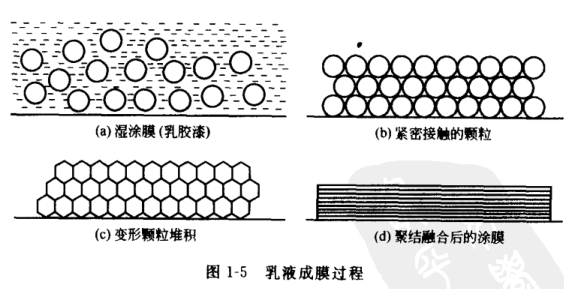
The minimum film-forming temperature of the emulsion is determined by the film-forming mechanism of the emulsion. The film formation of the emulsion needs to go through the following process: when the emulsion is coated on the substrate, the water evaporates, and the particles close together, as shown in the (b) stage in Figure 1-5. The remaining moisture continues to volatilize, generating capillary pressure, which is applied vertically to the water particle interface. When sufficient water evaporates, this capillary pressure can deform the polymer particles, as shown in (c) stage in Fig. 1-5. In a sense, the deformed polymer fills the gap left by water migration from the interstices of the emulsion particles, and makes further coalescence possible. Therefore, the creep of particles is an important stage of emulsion film formation, which is closely related to the ambient temperature T (essentially T-Tg). The higher the ambient temperature, the better the creep , and the better the performance of the coating film; on the contrary, if the temperature is too low, the polymer particles are too rigid, just like sediment, and cannot form a film up.
The minimum film-forming temperature of the emulsion is closely related to the glass transition temperature (Tg) of the polymer, but there is no mathematical formula between the two in terms of quantity. For emulsions without coalescents, MFT is roughly consistent with Tg. The MFT is fluctuated by the polarity of the polymer. If the polarity of the polymer is large, the minimum film-forming temperature of the emulsion is higher than the T, value, and if the polarity is small, the MFT value is lower than the Tg value.