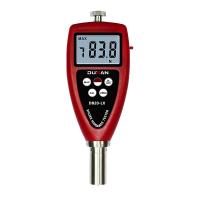
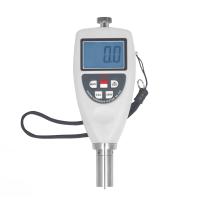
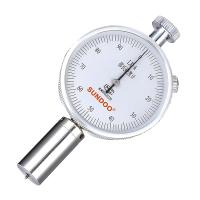
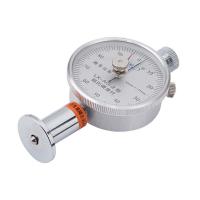
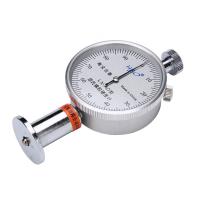
The two most common models of pointer Shore Hardness Testers are LX-A and LX-D. What is the difference between them?
This article mainly introduces the application of LX-A and LX-D Shore Hardness Testers. In the daily hardness measurement of rubber samples, many customers often do not know how to choose whether to use LX-A or LX-D Shore Hardness Testers. In fact, as long as we understand the differences and differences between the two, we can easily make a choice.

First of all, LX-A Shore durometer is suitable for measuring software rubber, that is, elastomer rubber, that is, rubber material with elastic surface. Generally, the hardness in the range of 20~90HA is suitable for LX-A type, also known as Shore A. For example, silicone, artificial leather, cable insulation and insulating sheaths, car tires, O-rings, rubber seals, etc. The hardness of the above materials or samples is generally homogeneous, soft or elastic, so the Shore A durometer should be selected.
LX-D Shore Hardness Tester is suitable for measuring vulcanized rubber or thermoplastic rubber with high hardness, that is, materials with no elasticity on the surface and relatively hard texture. Generally, samples with a hardness in the range of 90HA~100HA or more than 100HA. For example, plastic fan blades, plastic floors, plastic power switches, PVC, glasses plates, resin materials, polymer materials, etc., all of the above materials have little elasticity, so the Shore D Hardness Tester should be selected.
Next, let’s talk about the difference between LX-A Shore Hardness Tester and LX-D from the mechanical structure. According to GB/T 531.1-2008 "Vulcanized rubber or thermoplastic rubber - Indentation hardness test method part one"
The following schematic diagrams are the geometric dimensions of the indenters of the LX-A and LX-D Shore Hardness Testers:
It can be clearly seen from the figure that the Shao A indenter tip diameter is 0.79mm, which is relatively thick, while the Shao D indenter tip diameter is 0.2mm (that is, R0.1mm, radius 0.1mm) is a very thin needle tip. The lengths of their protruding presser feet are both 2.5mmm, that is, the protruding length of the indenter of the Hardness Tester in the free state is 2.5mmm. The geometric tolerance size and needle angle of the two are also different, which is also verified. As we mentioned above, why LX-A measures soft rubber, and LX-D measures hard rubber or plastic materials, because the size of the D-type indenter is particularly thin, its ability to press into the material is stronger, and solid measurement of hard materials is also There is no doubt about it.