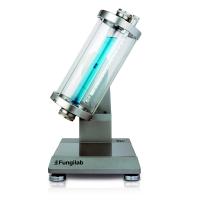
The falling ball viscometer is the simplest viscometer. Viscosity can be calculated by measuring the free-falling velocity of a ball of known size and mass in the measured liquid. Assuming that the liquid extends infinitely, when a ball with radius r and density ρ2 falls in the measured liquid with viscosity η and density ρ1 , its falling driving force Fw. is the difference between gravity and buoyancy.
Fw=4/3πr 3 ( ρ2- ρ1 ) g
The resistance Fv it receives is: Fv =6π ηvr
According to Newton's second law of motion, the equation of motion for a falling ball is:

When the steady state is reached, the falling speed of the ball remains unchanged, dv/dt=0, then the viscosity of the measured liquid is:

The advantage of the falling ball viscometer is that the instrument is simple, easy to operate, and does not require special equipment and technology; the disadvantage is that basic rheological parameters such as shear stress and shear rate cannot be obtained, and the shear rate is not uniform, so it cannot be used to study fluid properties. Dependence between viscosity and shear rate.