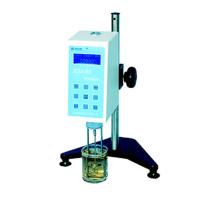
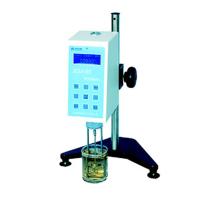
When liquid molecules move relative to each other, there are different internal frictional resistances. This physical characteristic that reflects the magnitude of internal friction when a fluid flows is called viscosity. Adhesive force is a physical quantity that expresses the stickiness or stickiness of a substance, and it reflects the amount of internal friction of a substance when it flows.

As shown in Figure 2-11, some kind of liquid is filled in the middle of two large plates that are very close to each other. The bottom plate is fixed, and a constant force F pushes the top plate to move along the y direction with a velocity v. At this time, the liquid between the two plates also divides into countless thin layers to move, forming a velocity gradient until the velocity of the lower layer is 0. The force parallel to the force surface is called shear stress, and the shear stress per unit area is called shear stress intensity, referred to as shear stress, expressed by σ . When stable relative motion occurs between two parallel liquid planes, the shear force σ is proportional to the velocity gradient dv/dx between the planes, that is
σ =ηdv/dx
Its proportional coefficient is the viscosity η . The above formula is the famous Newton's formula. In the formula, the rate gradient is also called the shear rate, represented by γ, and the unit is s -1 . Therefore, formula (2-13) can be written as:
σ = η γ
At a certain temperature and pressure, if the viscosity of the fluid is constant and does not change with the change of shear stress and velocity gradient, then this fluid is called Newtonian fluid.
In the International System of Units, the unit of shear stress σ is N/m 2 , the unit of shear rate γ is s -1 , and the unit of viscosity is Pa·s or N/(m·s). In centimeter gram second system (cgs), the unit of shear stress σ is dyn/cm 2 ( 1dyn/cm 2 =0.1Pa), the unit of shear rate γ is s -1 , and the unit of viscosity is P (poise) or gf/(cm s ). The relationship between the two units is 1Pa·s=10P.