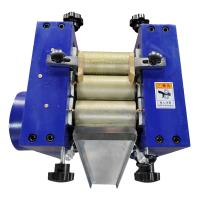
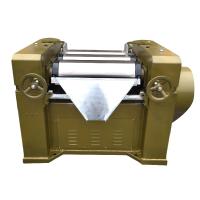
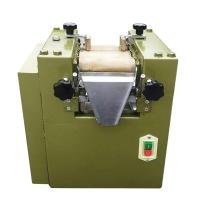
The working principle of the three-roll mill In the three-roll mill, the grinding and dispersion of the pigment starts from putting the paint into the space between the slow roll and the middle roll . Due to the inward rotation of the rollers, the millbase is drawn towards the feed gap. As the gap is getting smaller and smaller, most of the paint slurry cannot pass through, and is forced to return to the top of the feeding ditch, and then is taken down by the inwardly rotating roller again, forming a continuous making a circular flow, feeding This circulating flow in the ditch produces rather strong mixing and shearing. The more intense shearing action occurs at the moment of passing through the feeding gap, because the gap between the feeding gap is small (about 10~50μm), and there is simply a speed difference between the two adjacent rollers. At this point, the pigment aggregates in the millbase are broken and dispersed into the paint. A small part of the millbase passing through the feeding slot adheres to the slow roller and returns to the feeding ditch. Most of them adhere to the middle roller and enter the paint scraping gap between the middle roller and the fast roller.
In the paint scraping joint, due to the smaller gap and the greater speed difference between the fast roller and the middle roller, the paint paste is subjected to a stronger shearing action pigment aggregates are dispersed again. A small part of the paint paste passing through the scraping gap returns to the middle roller, most of it turns to the fast roller, and finally is scraped by the scraper to the scraper holder (outlet hopper) and flows into the movable paint basin. If the dispersion fineness does not meet the requirements, the operation can be repeated until it is qualified. ,