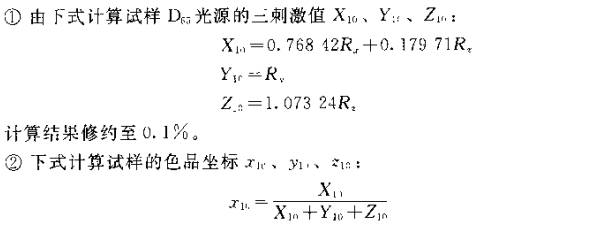
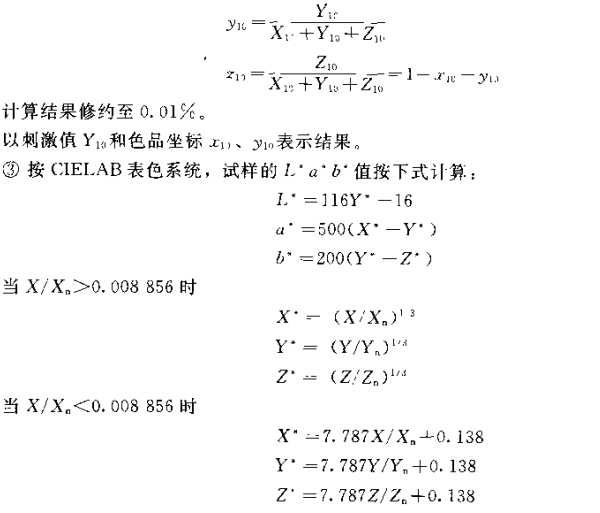
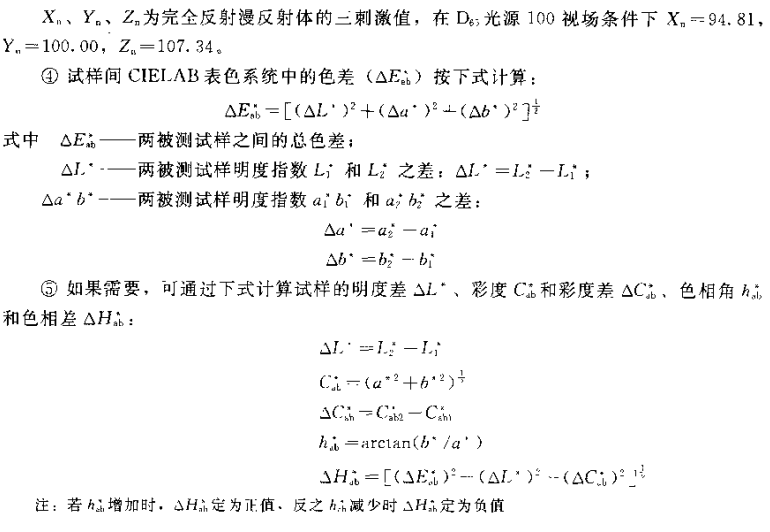
This method is only applicable to paper and board without fluorescent dyes. In order to improve the test accuracy, it is better to use a standard plate close to the color of the sample to calibrate the instrument for the dyed sample before testing.
1 definition
(1) The reflection factor R is the ratio of the radiant flux reflected by an object to the radiant flux reflected by a fully reflective diffuser under the same conditions, expressed as a percentage.
(2) Internal reflection factor R The reflection factor when the thickness of the sample layer reaches the reflection factor no longer increases with the thickness increase.
(3) The three-stimulus reflection factors R,, R,, R, using a photoelectric integral Colorimeter that complies with national standards, are the reflection factors measured under the conditions of the optical harmonic characteristics of the CIE1964 supplementary standard colorimetric system.
(4) CIE 1964 Supplementary Standard Chromaticity System: The chromaticity system represented by the color matching function value stipulated in CIE1964, also known as the 10° field of view chromaticity system.
(5) Tristimulus value ﹑ In the three-color system, the amount of the three original stimuli required to achieve color matching with the test light is called the tristimulus value of the test light. In X,, Y, Z. Chromaticity system, use X, Y, Z. Indicates tristimulus values.
(6) Chromaticity coordinates The ratio of each stimulus value to the sum of the three stimulus values, in the X, Y, Z chromaticity system, use x, y, z to represent the chromaticity coordinates.
(7) CIELAB color system and color difference formula, the visually approximately uniform color space and corresponding color difference formula suggested by the International Commission on Illumination (CIE) in 1976, represented by I"a°b" and △E respectively.
(8) Lightness index﹑in a visually uniform three-dimensional color space, it represents the coordinates of the object's color lightness value. When the I." value is О, it means a black body that fully absorbs light, and when the L' value is 100, it means that it fully reflects light. pure white objects.
(9) The chromaticity index α'b' represents the coordinates of chromaticity in a visually approximately uniform three-dimensional space. The positive value of u' indicates the reddish degree, the negative value indicates the greenish degree, the positive value of b° indicates the yellowish degree, and the negative value indicates the blued degree.
(10) Chroma indicates the color purity or saturation of an object.
(11) Hue angle h—the angle of the measured color within the range of 360° of the object's hue. Angle (is red, 90° is yellow, 180° is green, 270° is blue.
2 instruments
Photoelectric integrating Colorimeter. The three-stimulus reflex factors R, R, and R can be measured. , and its geometric and spectral characteristics should comply with the relevant regulations.
The overall spectral characteristics of the instrument's light source, integrating sphere, lens, filter and receiver match CIE standard D; the measurement conditions of the tristimulus value X0, Yo, Ze of the light source 10° field of view.
Working standard. For near-white samples, white T. can be used as a standard plate. For dyed samples, it is better to use a color work standard plate that is close to the color of the sample. The standard value of the working standard plate should be regularly calibrated and calibrated with the tertiary standard issued by the authorized laboratory.
3 Preparation of samples Sampling according to standard methods
Cut out no less than 10 rectangular test pieces of 150mm×75mm from the extracted paper, and the total thickness should reach the level where the reflection factor no longer increases with the number of layers. Each test piece is stacked face up to form a stack, and the upper and lower sides are lined with a test piece to protect them from soiling and unnecessary exposure to light or heat radiation.
4 test steps
① According to the instrument manual, use the calibrated T as the standard plate and black cylinder to calibrate the scale and zero point of the instrument.
②Remove the protective layer from the sample stack, put the sample on the test hole, test the tristimulus reflex factor R, of the sample on the top layer, and read the measured value with an accuracy of 0.]%.
③Remove the tested test piece and put it under the sample stack, repeat the test of the second piece. At least 5 pieces were tested for each sample. If needed. Turn over the sample stack, and repeat the inspection on the other side of the sample.
④ After measuring the reflection factor R, repeat the above operation to test Ry and R.
5 Calculation and representation of test results