Density is defined as: the mass per unit volume of an object at a specified temperature, and the commonly used unit is g/cm3 or g/ml. The purpose of measuring the density of a coating product is mainly to control the mass of a fixed volume in a product packaging container; It is also meaningful to measure the hiding power of the product , so as to know the area that can be coated per unit volume during construction.
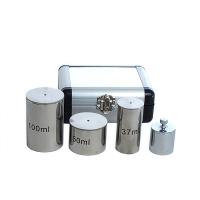
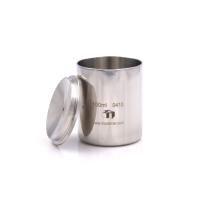
The current density measurement is carried out according to the national standard GB/T 6750-2007 "Determination of Density of Paints and Varnishes by Pycnometer Method" . The standard specifies the use of the pycnometer (mass/volume cup) method as a standard method for determining the density of liquid paints, varnishes and related products at a specified temperature . There are two kinds of pycnometers, one is a glass pycnometer with a capacity of 20~100mL; the other is a metal , as shown in the figure.
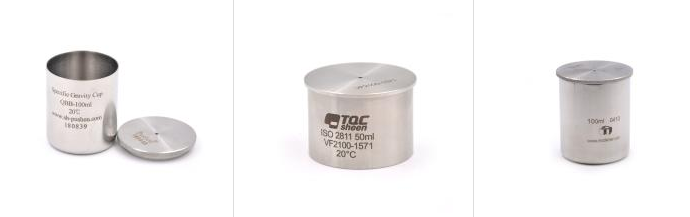
When measuring, at first calibrate the volume of the pycnometer with distilled water, then weigh the quality of the product and the pycnometer , and the density is calculated as follows:
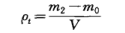
In the formula
m 0 —mass of empty pycnometer, g;
m 2 - mass of pycnometer and product, g;
V - the volume of the pycnometer at the test temperature, mL;
t - test temperature (23C or other agreed temperature), C.
In the inspection of finished products in the factory, metal specific gravity cups are mostly used, because they are easy to operate and easy to clean. However, it is necessary to prevent the sample from generating air bubbles in the specific gravity cup during the test, and at the same time, it must be weighed immediately and quickly to reduce quality loss. For coatings and oils that require more accurate density measurement, a Westphal balance can be used, but the operation is more complicated.