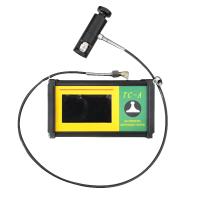
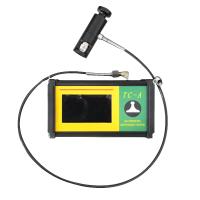
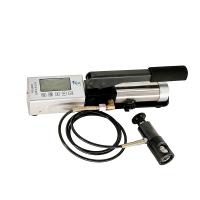
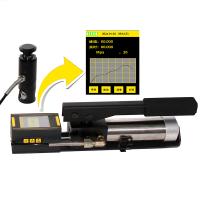
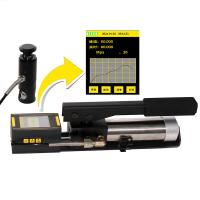
The pull-off method to measure the adhesion of the coating film is to apply a vertical, uniform and measurable tensile force on the cemented surface of the sample at a specified speed, and measure the force when the adhesion between the coating film and the substrate or the coating film is broken. Expressed in N/cm2 (kgf/cm2). There are many ways to measure the adhesion of the coating film by the pull-off method.
The pull-off method can be used to measure the adhesion of the coating film using a Tensile Testing Machine. The load of the Tensile Testing Machine should be of the same order of magnitude as the load of the test sample, and the clamps used in the test should be able to fix the sample. When the tensile force of the testing machine increases, a shear stress is applied to the bonded part of the sample until failure. Record the value of the tensile machine when the sample is bonded and broken, and observe the failure form of the section, whether it belongs to the damage of the adhesion between the coating film and the surface of the substrate, or the adhesion damage between the coating films. In order to determine the adhesion of the coating film to the substrate.
The pull-off method in GB/T 5210 "Determination of Adhesion of Anti-corrosion Coatings" is equivalent to the method of measuring the adhesion of anti-corrosion coatings using the ASTM D-4541 portable adhesion Tester. It is also the determination of the effective adhesion between the samples pulled apart by the tensile machine to calculate the adhesive strength of the coating.
The test process is to use a specific strong adhesive to bond the anti-corrosion layer and the substrate to the two drawing die heads of the tensile machine, and then put the prepared sample into the upper and lower clamps of the tensile machine and adjust them to the center. , to ensure that its cross-section is evenly stressed. Then turn on the machine and perform the pull-off test at a specified speed, and record the maximum force value of the sample bonding failure.
According to the condition of the cross-section after pulling apart the damage, it can be analyzed whether the damage belongs to the damage of the adhesion between the anti-corrosion layer and the surface of the substrate, or the damage of the cohesive bonding between the coating film and the coating film, etc. Since the pull-off method can more scientifically reflect the adhesion between the coating film and the substrate, it has been used more and more in the performance testing of coatings for heavy-duty anti-corrosion coatings.
SY/T 0041-1997 "Shear Strength Test Method for Pipeline Anticorrosion Coating and Metal Bonding" is a standard method for determining the bonding performance between pipeline anticorrosion coating and pipeline surface formulated by the oil and gas pipeline industry in accordance with the American ASTM D-1002 standard.
This standard refers to the US ASTM D-1002, and formulates a shear strength test method specially used for the bonding of pipeline anti-corrosion coatings and metals. It uses a mechanical Tensile Testing Machine, and the test piece used is composed of two steel pieces of the same specification. The two steel test pieces are bonded together with one side of the paint, and after the paint is completely cured, the two test pieces are pulled apart by a Tensile Testing Machine. Calculate the shear strength from the tensile force and bonded area.
Foreign and domestic studies have shown that the adhesive force between the anti-corrosion coating and the metal pipeline measured by SY/T0041-1997 (Shear Strength Test Method for the Bonding of Pipeline Anti-corrosion Coatings and Metals) is more consistent with the force of the pipeline in the soil. The post-corrosion protection layer matches whether the pipeline peels off. This method is also not suitable for the construction site.
In the oil and gas pipeline industry standard, the bonding strength to the pipeline anti-corrosion coating can also be evaluated by quantitative measurement of peel strength. That is, the peel strength of the anti-corrosion layer is used to evaluate the effective bonding degree between the outer anti-corrosion layer of the pipeline and the surface of the steel pipe. This method is also the same as the detection principle of the pull-off method. In the industry standards of oil and gas pipelines, the specific force measurement method is stipulated. For example, in the appendix of SY/T 0413 on the measurement method of the bond strength between the three-layer polyethylene anti-corrosion coating and the steel pipe, it is stipulated: "First draw the anti-corrosion coating When cutting a strip with a width of 20-30mm and a length of more than 10cm, the anti-corrosion layer should be cut through, and one end should be pried up. Make the dynamometer perpendicular to the steel pipe surface and pull up the polyethylene layer at a uniform speed of 10mm/min, record Force counting value. Divide the force value recorded during the measurement by the peeling width of the anti-corrosion layer, which is the peeling strength, in N/cm. The measurement result is expressed as the average value of three measurements."
It is stipulated in the SY/T0413-2003 standard. The peel strength value of the polyethylene anti-corrosion layer and the steel pipe measured at room temperature should be ≥100N/cm, and the peeling strength at 50°C±5°C should be ≥70N/cm. The above values show that the bonding between the composite polyethylene anti-corrosion coating and the surface of the steel pipe under the process conditions specified in the SY/T 0413-2003 standard is very good. A series of treatment measures such as shot blasting treatment and dust removal have been carried out for surface pretreatment. The bottom fusion bonded epoxy powder anti-corrosion layer adopts high-voltage electrostatic spraying technology, and the excellent adhesion performance of the excellent copolymer primer is very good. This standard method refers to the provisions of the German Industrial Standard DIN 30670. This method is suitable for construction sites.