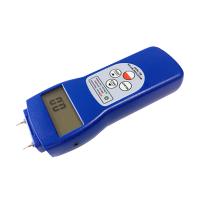
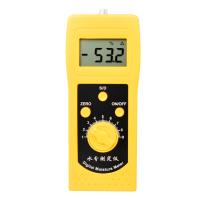
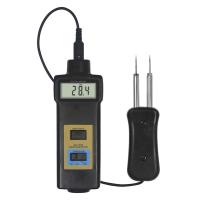
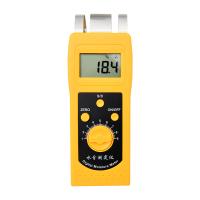
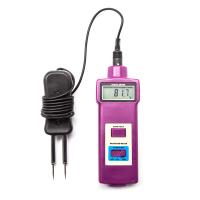
The moisture content of the paper refers to the ratio of the reduced mass to the original mass when the paper sample reaches the "constant weight" at the specified drying temperature (105±2) °C, expressed in %.
The method of measuring moisture is to take two paper samples of a certain mass (accurate to 0.0001g), put them into the "weighing bottle" with constant weight, and dry them in a hot air drying box for several hours (generally 4h). Weigh it after cooling for 30 minutes. If it does not meet the requirements, dry it repeatedly until the weight is constant. Then, divide the difference between the quality before and after drying by the quality before drying, and through simple calculation, the moisture content of the paper can be obtained.
The air generally contains a certain amount of moisture. When the moisture in the air is greater than the moisture contained in the paper, that is, when the climate is humid, the paper will absorb the moisture in the air. Conversely, when the climate is dry, the moisture will be desorbed and transferred to the air until the moisture balance is reached between the two. It should be pointed out that the effect of such adsorption and desorption is shown as two isotherms, and the desorption curve is above the adsorption curve (called hysteresis). Therefore, the moisture content of paper changes with the dry temperature of the climate. Usually, the moisture in the air is about 7%, and the moisture of ordinary printing paper is 7%±2%. If it exceeds this limit, it means that the moisture in the paper is unqualified, and you can claim compensation from the merchant.
The moisture content of paper will affect many of its properties. From a printing point of view, moisture has almost an impact on paper size, stretch rate, tensile strength, surface strength, etc., which should not be underestimated. Too much moisture in the paper will make it difficult to overprint, delay the drying of the ink, and reduce the tensile and surface strength; Zhang" and other quality issues.