(1) The nature of the three primary colors of the pigment
The primary color of each color material can subtract the corresponding 1/3 of the white light (that is, a primary color light), and reflect two primary color lights. Therefore, the primary color of the colorant is the result of mixing the two primary colors of light. For example, magenta is a mixture of red light and blue light, yellow is a mixture of red light and green light, and cyan is a mixture of green light and blue light, but the reflection of the actual three-color ink relative to the visible spectrum is imperfect.
(2) The position of the three primary colors of the color material in the chromaticity diagram
All colors can be displayed on the CIE chromaticity diagram, and the three primary color inks can also express their property errors on the chromaticity diagram.
In theory, the three primary colors of pigments have the versatility of mixing or stacking into various colors in a very large range. But in fact, the three primary colors of the pigment have defects, that is, it is impossible to completely absorb and reflect the colored light that it should absorb and reflect. The figure below shows the corresponding positions of the currently used three-color inks and their secondary colors (three primary colors) on the CE chromaticity diagram. Based on the C light source, their coordinate values are as follows:
| yellow ink | Y=0.86 | x=0.437 | y=0.485 |
| magenta | Y=0.26 | x=0.408 | y=0.226 |
| Green ink | Y=0.28 | x=0.176 | y=0.226 |
| yellow + magenta = red | Y=0.25 | x=0.565 | y=0.356 |
| Yellow + blue = green | Y=0.20 | x=0.257 | y=0.477 |
| magenta + cyan = blue | Y=0.06 | x=0.230 | y=0.129 |
It can be seen from the figure that the three-subtracted primary colors have a very narrow range of spectral chromaticity in the entire chromaticity diagram. Therefore, it is impossible for the three primary colors of pigments to reproduce the desired hue, lightness, and chroma in the color of space objects. From the lightness Y value, the lightness of each color after mixing is lower than that of the primary color.
In the densitometer colorimetric method, the hue error and gray scale of the three-color ink and the secondary color obtained after mixing are measured.
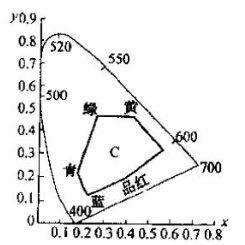
Figure 1 The positions of the three primary colors on the CE chromaticity diagram
(3) Mixing and superposition of colorants
There are two ways to realize the subtractive color method, that is, the mixing and superposition of color materials. In the printed matter of color printing, a variety of colors are expressed by the reconciliation or nesting of color inks. Due to different forms and limited by conditions, the color results can only be similar.
Ink reconciliation: Take the reconciliation of yellow ink and magenta ink as an example. In this way, the yellow pigment and magenta pigment are mixed and dispersed in the ink binder, and printed on white paper. Enlarge a part of it. When white light is irradiated, the blue light is first absorbed by the yellow pigment, and then the green light is absorbed by the magenta pigment, and the remaining red light is reflected by the white paper, so it is red. Similarly, when yellow and cyan are mixed, the blue light is absorbed by the yellow pigment, and only the green light is reflected, so it becomes green. If the three primary colors of magenta, yellow, and cyan are mixed, the three primary colors are absorbed by the three color materials respectively, so it should be black, but because it is not completely absorbed, and the absorption amount of each color is also different, so only the color cast can be obtained. Approximate black, which is one of the applications of subtractive color method. It can also be expressed by the following relation:
Y(yellow)+M(magenta)=W(white)-B(blue ) -G(green)=R ( red)
Y+C=WB- R= G
M + C=WGR=B
Y+M+C=WBCR=BK(a)
Ink stacking: In color printing, the stacking of two or more primary color inks is often used to generate new colors to increase the number of colors and soften the tone, and the result is the same as the mixing of colorants. An example is the case where yellow ink overprints on a magenta ink layer. White light passes through yellow ink, blue light is absorbed, and then through magenta ink, green light is absorbed, leaving only red light, which is reflected by the underlying white paper. Therefore there are also:
Y+ M=R
Y+C=G
M+C=B
Y+M+C=BK (approximate)
The above are all in terms of transparent coloring materials, such as transparent yellow, magenta, and cyan film sheets overlapping each other, and the above effects can also be obtained.
If it is the overlapping of opaque pigments, no matter what the background color is, only the surface color will be shown.
The red, green, and blue obtained by mixing the two primary colors in the above three subtractive primary colors, or orange, blue lotus, grass green, etc. obtained by different proportions, are called secondary colors. The color formed by mixing the three primary colors in different proportions is called complex color.
In short, as a result of the subtractive color method, the brightness of the color is greatly reduced, and the more it is reduced, the darker it becomes. It can be seen from the spectroscopic curve that their superposition is the product value of reflectivity. For example, in a group of three-color printing inks, the red reflectance after overlapping magenta ink and yellow ink reaches 85%, and the hue is slightly deviated.
It can be seen that the subtractive color method uses the three primary colors of the pigment according to a certain amount of components and pigments, and can also mix a wide range of hues like the additive color method. The mixing formula is as follows:
φ=αM+βY+γC
Take φ as the result of subtractive color mixing (including achromatic type), and α, β, y are the variable ink volumes of three subtractive primary color inks. According to such a ratio, using the subtractive primary colors, a large number of various basic hues can be obtained, that is, monochromatic, secondary and complex colors.
In color printing products, color dot plate printing uses three subtractive primary color dots to form its complex color changes, in which there are two parts of superposition and juxtaposition of three-color dots. The overlap of dots of each transparent primary color is purely a color reduction phenomenon, while the juxtaposition of colored dots is the same as the phenomenon that new colors are formed by interweaving warp and weft threads of different colors, all of which belong to the spatial mixing of shades, and the actual effect is the same as that of the subtractive color method. same.
(4) gray ink
All the colors of objects are the result of stimulating human eyes by reflecting various visible light wave energies. There are no white, gray, and black colors in the solar harmonics. These colors are called achromatic colors. It is a kind of object that reflects and absorbs various spectra uniformly. Due to the difference in uniform reflectivity, the relative energy has a size. Therefore, the difference between them is only the difference in lightness. In the achromatic color scale, there are many filter colors from the brightest to the darkest, generally called white, light gray, gray, dark gray, black and so on. The difference between these colors depends on the result of human vision on the amount of light hit by the object and the amount of reflected light. The more light reflected from the surface of the illuminated object, the brighter the color will appear. For example, barium white reflects 99% and zinc white 94%. If the reflection of light is 70%, then the eyes see gray. If it only reflects about 10%, it is dark gray. Black ink reflects about 2.4%.
Achromatic colors can only be compared relatively, because the object does not reflect the energy of various visible light waves very uniformly, so the spectral spectroscopic curve will not be an absolute horizontal straight line, so the phenomenon of color cast always occurs. For example, newsprint is yellowish, tracing paper is blue, light source A is reddish, and light source C is blue. Books and periodicals are black and ink yellowish, etc. Although these objects are all achromatic colors, they actually have a color tendency.
In theory, the same amount of three primary color inks can be used to adjust the gray series of inks, but this will waste a lot of color inks and it is difficult to achieve a correct gray. In practice, according to the requirements of the original manuscript, black ink and white ink are often used to produce the gray between Xi and white, which is easy to adjust and easy to obtain an accurate gray.
