According to FICCI, paperboard products account for more than 30% of the packaging industry. That's because corrugated boxes are so popular. For example, conventional slotted containers are one of the most widely used boxes for shipping and storage. Corrugated boxes are inexpensive, durable and environmentally friendly. However, not all boxes are created equal. That said, they vary widely in compressive strength, thickness, chemical resistance, and other factors.
This is what you need to know when you need to choose the right corrugated box for your packaging needs. The strength and structure of the cardboard directly affects the weight the box can carry. A box that is too weak may puncture or collapse. On the other hand, too many boxes means you pay extra for materials and increase environmental waste.
To determine how well corrugated boxes will hold up to external influences (and to help you make an informed decision when picking a box), manufacturers use a variety of testing procedures.
This is a summary of common corrugated box test methods used to check the strength of corrugated boxes.
#1 – Burst Strength Test
Contents: Test chamber strength when subjected to pressure
Why: To determine the exact weight a box can carry, take a rough
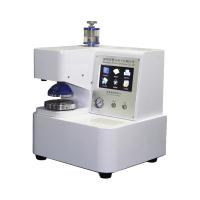
The Mullen test or burst strength test is used to check the toughness of a corrugated cardboard wall when it is subjected to stress or pressure. During this test, a rubber diaphragm is used to apply pressure to the wall of a corrugated box until it ruptures. The diaphragm is inflated using hydraulic pressure, and as the diaphragm expands, the corrugated cardboard ruptures under the pressure.
We measure burst strength in kilograms per square centimeter. The burst factor is one thousand times the burst strength divided by the grammage of the board.
Bursting rate = bursting strength (kg/cm 2 ) x 1000/gram weight (gm/m 2 )
#2 – Edge Squeeze Test
Contents: Transverse crushing of corrugated cardboard
Why: To test material quality, stack strength, pallet transport durability
One of the popular methods for testing the stack strength of corrugated boxes is the "Edge Crush Test" or ECT.
Each side of a corrugated box consists of three or more layers of thin sheets. Typically, a thin plate with grooves and ridges is sandwiched between two flat plates. These grooves and ridges (also known as flutes) provide the box with anisotropic strength. This means the box can take more force from one direction. An edge squeeze test, right side test, or flat squeeze test helps determine this.
In the Edge Crush test, force is applied to one side of the box perpendicular to the ridge until the box is crushed. In the Ring Crush test, a ring cut out of a box is used for the test. In a flat compression test, excessive force is applied to one side.
The results of the edge crush test are measured in pounds per linear inch of the loaded edge, but expressed as ECT.
Strength of single wall corrugated cardboard:
| Burst test | Minimum Edge Extrusion Test | Maximum load per box |
| 125# | 23 ECTs | 20 pounds |
| 150# | 26 ECT | 35 pounds |
| 175# | 29 ECT | 50 pounds |
| 200# | 32 ECTs | 65 pounds |
| 275# | 44 ECT | 95 pounds |
| 350# | 55 ECT | 120 lbs |
Strength of double-layer corrugated cardboard:
| Burst test | Minimum Edge Extrusion Test | Maximum load per box |
| 125# | 23 ECTs | 20 pounds |
| 150# | 26 ECT | 35 pounds |
| 175# | 29 ECT | 50 pounds |
| 200# | 32 ECTs | 65 pounds |
| 275# | 44 ECT | 95 pounds |
| 350# | 55 ECT | 120 lbs |
ECT gives you an accurate idea of the strength of the boxes when palletized and transported. Also, ECT rated corrugated boxes use less material than equivalent Burst Test rated corrugated boxes to provide equivalent strength. This means it is cheaper to buy ECT grade boxes in bulk and there is less waste.
However, it is important to know that the above results (the overall strength of the box) may vary depending on the composition of each corrugated sheet. Therefore, it is important to understand the type of ripple before making a decision.
#3 – Water Resistance of Glue
What: Testing the water resistance of corrugated board glued lines
Why: To test the effects of climate conditions, moisture permeability, and water absorption
Even though the fiberboard itself can absorb and retain water, it is important to test the waterproofness of the bond or seal. For some applications, the FEFCO 9 standard is used to test the water resistance of corrugated box bonds.
In this type of test, corrugated cardboard is immersed in water while exposing the glue lines to check bond strength and water absorption.
#4 – Cobb Size Tester
What: Checks water resistance and measures weight gain when exposed to water
Why: To test box quality, porosity
The raw materials used to make corrugated fiberboard have a tendency to absorb moisture and retain it. The degree of use of the Cobb Sizing Tester depends on the degree of water absorption.
In this test, corrugated fiberboard is first subjected to a water treatment. Then, use pressure to force the water out of the sample. Usually, depending on the quality, not all of the water will be removed despite heavy steel rolling the boards. The difference in weight due to retained water is called the Cobb value.
The lower the Cobb value, the better the water resistance. Certain certifications, especially those involving packaging of hazardous materials, require Cobb testing.

#5 – Paper Weight and Thickness
Contents: Test areal density and thickness
Why: To test the mass and stiffness of the box
Gram weight and thickness are the two most basic characteristics of corrugated boxes, which determine the quality of the box. There is no "right" grammage or thickness mentioned in corrugated box specifications, it all depends on your requirements.
When more padding is required, a thicker box can be used. Corrugated cardboard has larger flutes and holds more air in them. Sheets with dense grooves have a high grammage. Such boxes are required when the packaging should be more compact and robust.
Thickness is usually measured in millimeters and grammage is expressed in grams per square meter (g/m2).
Thinner boards are easier to fold when folded or printed, lighter and more suitable for use. The thicker ones are stronger and suitable for heavy transport. Generally, the type of flute (A, B, C, E or F) determines the strength of the cardboard, with C being common (4.0mm).
Standard corrugated groove:
#6 – Puncture Resistance
What: Tests resistance to penetration by sharp solid objects
Why: Test cardboard for strength and sturdiness during shipping
The puncture resistance test box handles the impact of pyramid or triangular weights well. Test standards for puncture-resistant corrugated boxes include FEFCO 5 or ISO 3036.

#7 – Scratch Resistance Test
What: Check the durability of the printed or color box against wear and tear
Why: To ensure that the printed text on the carton can continue to rub, wear
Printing is a very important part of packaging. When using different types of printing methods, it is important to check how well the label or print will handle scratches or abrasions. For this purpose, scratch resistance or rub resistance tests are used. The Sutherland Rub Test is an industry standard test procedure. Use this procedure to test coated surfaces such as paper, film, cardboard and all other printed materials.
Abrasion resistance can also be tested using other corrugated box testing methods. These include spinning wear Testers and even manual swabbing. Scratch resistance testing is especially important for the pharmaceutical or medical industries where label legibility is of paramount importance.
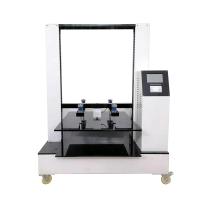
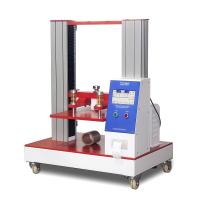
#8 – Box Compression Test
Contents: Testing the compressive strength of corrugated boxes
Why: To measure the stacking strength of palletized loads
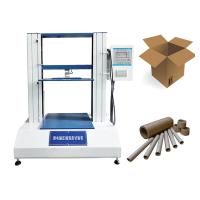
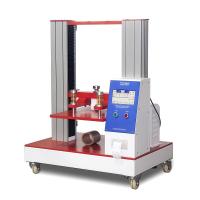
Box compression testing (also known as container compression testing) is a method of testing the maximum amount of load and deformation a box can withstand before it deforms. It gives us a good idea of how many boxes can be stacked together without damaging the contents of the bottommost box. The importance of this test to check the strength of boxes cannot be overemphasized and is required for bulk box shipments in most industries.
Boxes are tested in different orientations. These should also be considered if the box design uses internal supports such as wood supports or corrugated cardboard underlayment.
The compressive strength of a corrugated box can also be calculated using the McKee formula, which takes into account the edge crush test (ECT), calipers or corrugated board thickness (CBT) and the carton perimeter (P) value.
According to McKee formula: Compressive strength = 5.874 * ECT * CBT 0.508 * P 0.492
#9 – Chemical Analysis in Corrugated Box Testing
What: Test the resistance of the case to chemicals
Why: To check product formulation and regulatory compliance
For some applications it is necessary to check the properties of the fibreboard and its resistance to certain chemicals, a chemical analysis is required. Fiberboard analysis includes microscopic examination of the fiberboard to look at the type of paper used to make it. In addition, the moisture content of the panels as well as the pH were determined.