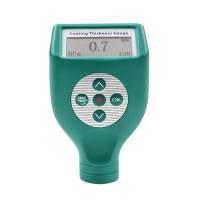
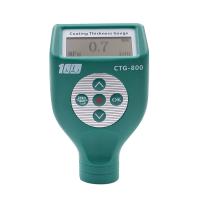
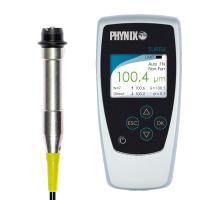
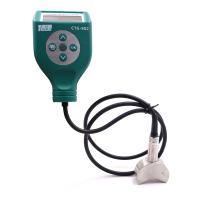
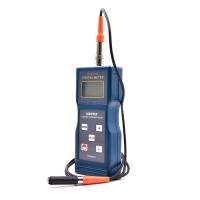
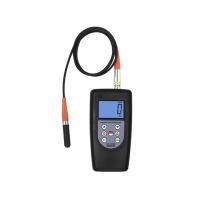
Handheld, non-destructive coating Thickness Gauges manufactured by DeFelsko are ideal for measuring wear on organic photoconductor (OPC) photosensitive drums.
The OPC drum is the most expensive component in the toner cartridge and drives the entire printing process. Life expectancy is exhausted after 5 to 15 microns (0.2 to 0.6 mils) of coating wear away. Scrap decisions are usually made automatically when wear approaches half its original thickness.
measurement challenge
OPC rollers require accurate non-destructive measurements to facilitate critical reuse and wear analysis decisions. OPC rollers typically have a coating thickness of around 50µm (2 million mils), although this varies between manufacturers and products. Since OPC wears even down to a few microns (tenths), it cannot be overemphasized that repeated measurements on the curved surface of the OPC drum are important for obtaining accurate results.
Dry Film Thickness Measurement Solutions
Our PosiTector 6000 NAS series is the simple, most cost-effective method for non-destructively measuring the thickness of OPC coatings. NAS probes are designed for high-resolution measurement of non-conductive coatings (OPC) on non-ferrous (aluminum) substrates. Although capable of measuring NAS probes up to 625 μm (25 mils), it is precise and provides the highest resolution down to 100 μm (4 mils). This suitable probe range is well within most manufacturers' expected OPC coating thicknesses.

When a customer identifies their application as "OPC Drum Measurement," DeFelsko provides a custom plastic V-groove adapter for the probe. The grooves on the adapter are designed to fit a variety of OPC drum sizes from various manufacturers. As shown in the image below, the adapter ensures that the probe is always placed perpendicular to the surface of the OPC drum, optimizing accuracy and repeatability. When measuring, the plastic adapter also protects the OPC coating from possible physical damage caused by stainless steel probes.
Before measuring OPC coatings, it is important to zero the probe on the uncoated drum to better reduce the effects of curvature and any existing base coating on the aluminum drum. Note that for accurate measurements, the surface of the OPC should be smooth, clean and free of toner.
Background of OPC
What is an application?
The OPC (Organic Photoconductor) drum is the most expensive component in the toner cartridge and drives the entire printing process. OPC drums consist of a non-conductive (organic) coating on a non-ferrous (aluminum) substrate. OPC drums are used in abrasive environments where the surface is worn away by toner, wiper blades and paper dust.
Why measure?
The life expectancy of an OPC drum is considered exhausted when 5 to 15 microns (0.2 to 0.6 mils) of the coating has worn away. Scrap decisions are usually made automatically when wear approaches half its original thickness. Therefore, the ability to measure OPC coatings enables remanufacturers to maintain quality standards while getting the most out of each OPC drum. Another benefit of quick measurements to determine suitability for re-use is that scrap can be decided before further processing such as cleaning, polishing or coating.
The ability to measure OPC wear also enables remanufacturers to optimize their purchasing decisions for other cartridge components. The most cost-effective components for each make and model of OPC toner cartridges can be determined by monitoring the wear effects of various wiper blades, lubricants, toners, OPC finishes, and paper types. In order to monitor the effect of wear on the OPC coating, it is recommended to record several measurements along the length of a new OPC drum. After experimental testing or actual customer use, re-measure in the same area and record the new thickness value. Subtract the before and after values to calculate the OPC film thickness wear.
Where is the market?
Remanufacturers of printing and copier ink cartridges are a major market for measuring OPC coatings. As ink cartridge printers continue to mature in the market, it is expected to experience heavy price pressure. Remanufacturers who are able to measure OPC thickness have the additional information necessary to make decisions in a competitive market.