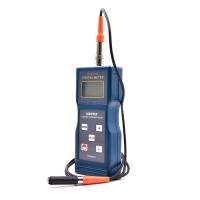
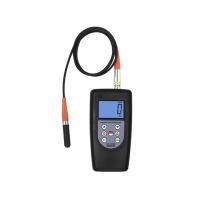
DeFelsko制造各种手持式,非破坏性油漆测厚仪,非常适合测量电线上的涂层。
测量挑战
为了非破坏性地测量导线和小直径基板上的非磁性涂层的厚度。
涂层厚度测量解决方案
选项1
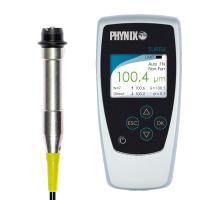
所述 PosiTector 6000 ˚F微探针 系列包括3个应变计,其测量涂层达45密耳(1150微米)厚,从而使它们适合用于在低至80密耳直径(14表压)亚铁导线大多数涂料的非破坏性测量。为了在小直径上获得合适结果,带有V形槽的快速释放适配器可确保合适对准,从而将铁质微探针转换为恒压探头。通过将微探针安装在探针固定架上以确保每个零件的可重复定位,可进一步提高可重复性。45和90度的微型探头也可用于笨拙或难以到达的测量位置。三个 PosiTector 6000 N微型探针 设计用于在直径稍大的有色(非钢)电线上进行测量。
测量过程很简单。仪器在裸线上归零,称为校准调整。然后可以对具有相似基材和直径的涂层零件进行准确且可重复的测量。为了简化测量过程,适用的PosiTector 6000型号长久存储校准调整,可能对每个导线基板和直径都进行校准。所有类型的探头都具有低至1%的精度和0.01百万(0.5微米)分辨率的潜力,具有很好的性能。

PosiTector 6000的高级型号(型号名称带有“3”标识)具有多种强大功能,非常适合这些类型的测量应用程序。为了进行统计过程控制,仪器会在测量过程中连续显示和更新读数数量,平均值,标准偏差,最小和最大厚度读数。此外,HiLo功能可设置上限和下限,当任何测量值超过指定限制时,可向操作员提供听觉和视觉警报。为了保存记录,最多可以将1,000个不同批次中的100,000个读数存储起来,以供将来分析和下载。
选项#2
尽管 PosiPen 机械量规具有较低的精度和分辨率,但它却提供了具有类似测量功能的经济有效的替代方案。PosiPen的优势尤其在于它能够直接测量高温应用而不会损坏探头。
电线涂层的背景
常见的涂料应用?
Most electrical wires sold today have a protective coating to prevent wear, damage, and corrosion. Some common wire coatings include chrome, porcelain, galvanized, aluminum, epoxy, polyester, polyethylene, PVC, and paint.
The chrome plating of steel cookware grills is primarily decorative while providing some corrosion protection. They are often used as heating racks.
The porcelain coating of the steel grill prevents food from sticking and corroding. The quality of the grill is directly related to the coating thickness of the rod and porcelain.
Galvanized is the main coating for chain link fences, widely used in tennis courts, gymnasiums, parks, industrial units or any places that require security protection. Chain Link fencing fabrics are available in a variety of gauges ranging from 16 to 4 gauge (64 to 232 mils). Zinc is a self-sacrificing element that slowly dissipates, thus protecting the steel from corrosion. Therefore, the lifetime of the protective layer is directly related to the thickness applied. The quality of a chain link fence depends on the gauge of the wire and the thickness and consistency of the galvanizing.
Wire Gauge and Diameter Conversion Table

Galvanized steel wire mesh is usually made from low carbon 12-14 gauge steel wire. It is used as reinforcement for roofs and floors of buildings, partitions for walls, and fences for animal cages, kennels, fish gardens, lobster traps, gardening and playground safety.
Aluminum and aluminum alloys are also used as corrosion protection for steel chain link fencing. When applied at the same thickness, aluminized wire can resist corrosion for up to five times as long as galvanized wire.
Epoxy coatings are commonly used to protect rebar, wire mesh and dowels. Common specifications for epoxy coatings applied by the electrostatic powder spray process range from 7 to 12 mils (175 to 300 microns), with a minimum acceptable value of 5 mils (125 microns).
Polyester, such as nylon, is powder coated onto wire products such as dishwasher baskets, shopping carts, and bike racks. A dishwasher basket may contain 10 to 25 mils (250 to 625 microns) of coating, while a bike rack may only require 6 to 8 mils (150 to 200 microns). Nylon coatings are popular for their attractive appearance as they offer resistance to corrosion, cleaning and rinsing agents, moisture, abrasion, abrasion, stains and impact.
Polyethylene is a commonly used thermoplastic coating for refrigerator shelves due to its corrosion barrier. Polyethylene is considered safe for contact with food, pharmaceuticals and drinking water. Features include consistent custom coloring, good impact strength, economical, high gloss, smooth surface, good durability and flexibility, good adhesion, single layer high thickness, easy application and facile coating, Corrosion protection and enhanced product look and feel. Thermoplastic coatings are also used in bike frames as they are highly impact resistant (bike friendly) and UV stable when applied at a thickness of 8 to 12 mils (200-300 microns).
Polyvinyl chloride (PVC) is a powder coating that balances various properties including softness, rubbery feel and resistance. PVC powders generally have very good impact resistance, chemical resistance, outdoor durability, color uniformity and toughness. For this reason, PVC is commonly used in bicycle racks, dishwasher baskets, and food contact applications such as refrigerator racks and freezer baskets. The aesthetically pleasing extruded PVC coating is usually galvanized over 6 to 14 gauge galvanized fence wire for extra environmental and corrosion protection. Extruded PVC coating is applied to galvanized core wire at a maximum coating thickness of 25 mils (625 microns). Vinyl powder coating produces an even coat in one coat, starting at 7 mils (175 microns) in thickness. Extruded PVC Coating is a high strength galvanized steel chain link fencing fabric used in industrial, commercial and institutional applications. Extruded fabrics are covered by local, state and federal government specifications for prisons, roads, docks, airports, housing, forestry and military applications.

Low lead and zinc paint was powder coated to the large iron and stainless steel birdcages. Iron cages need to be fully covered and have bond strength to prevent the danger of toxic poisoning from peeling paint or iron cages.
Why measure?
Despite the wide range of coatings available, one common denominator is that corrosive and protective coating applications typically have a range of allowable thicknesses. If the thickness is too thin or too thick, it may cause premature failure. The process of coating small diameters such as wire has many variables to control. Consider the powder coating process, where preheat temperature and time, dipping time, and postheat temperature and time all affect the final coating thickness.
To comply with applicable ASTM specifications, and in other applications where coating quality and cost need to be controlled, changes in coating thickness need to be monitored and controlled. Additionally, coating Thickness Gauges can be used for quick, inexpensive on-site inspections to ASTM standards that require stripping and weighing coatings.
Applicable standard
A116-00 Standard Specification for Metal-Coated Steel Wire Woven Fence Fabrics
A185-02混凝土用普通普通钢丝焊丝增强标准规范
A392-03镀锌钢链节围栏织物的标准规范
A460-94(2004)E1铜包钢绞线的标准规范
A491-03铝涂层钢链节围栏织物的标准规范
A641 / A641M-03镀锌(镀锌)碳钢丝的标准规范
A775 / A775M-04a环氧涂层钢钢筋的标准规范
A856 / A856M-03 5%锌-铝混合金属合金涂层碳钢线的标准规范
A884 / A884M-04环氧涂层钢丝和焊丝增强的标准规范
F668-04聚氯乙烯(PVC)和其他有机聚合物涂层的钢链节围栏织物的标准规范
F1043-04金属工业链节围栏框架上的强度和防护涂层的标准规范
F1345-96(2003)-5%锌的铝-多金属金属合金涂层的钢链节围栏织物标准规范
F1553-01标准指南,用于指定工业和商业链节围栏
F1664-01与链节栅栏一起使用的涂有聚氯乙烯(PVC)的钢张力线的标准规范
联邦规范RR-F-191 IV型, 栅栏,金属丝和金属柱(链节式围栏织物)
美国国家公路运输官员协会(AASHTO)M-181(2002) 链节围栏
AASHTO M-284 环氧涂层钢筋
依赖涂层重量进行厚度测量的其他适用标准:
A111-99a(2004)e1镀锌(镀锌)“铁”电话和电报线路电线的标准规范
A121-99(2004)Mettalic-coated碳钢刺铁丝网的标准规范
A363-03镀锌(镀锌)钢架空接地线绞线的标准规范
A475-03镀锌钢绞线的标准规范
镀锌钢结构钢丝绳的A603-98(2003)标准规范
A741-98(2003)中文版Standard Specification for Zinc-coated Steel Rope and Fittings for Highway Guardrail
A809-03铝涂层(镀铝)碳钢丝的标准规范
A817-03链节栅栏织物和马氏张力线的金属涂层钢丝的标准规范
A824-01与链节栅栏一起使用的金属涂层钢马氏张力线的标准规范
A854/A854M-98 (2003) Chinese Version Standard Specification for Metallicated Steel Smooth High Strength Fence and Gridlines
A975-97 (2003) Chinese version Standard Specification for Double-Twisted Hexagonal Mesh Gabions and Revet Mattresss (Metallic-Coated Steel Wire or Metallic-Coated Steel Wire with Poly (Vinyl Chloride) (PVC) coating) A975-97 (2003) standard specification