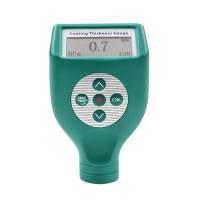
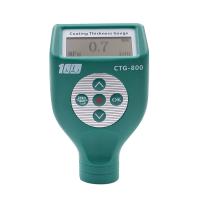
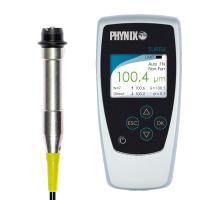
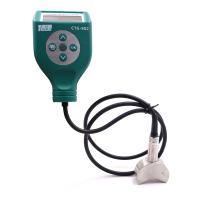
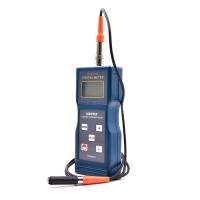
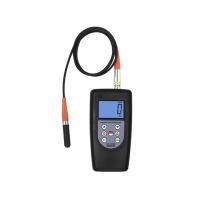
DeFelsko's PosiTector 6000 Coating Thickness Gauge is ideal for measuring critical dimensions on offset printing equipment. It provides quick and easy blanket, pack and plate thickness measurement to ensure good print quality and low maintenance costs.
application
Offset printing is a common printing technique in which an inked image is transferred or "shifted" from a metal plate on a rotating cylinder to another cylinder covered with a blanket. The image is then transferred from the blanket to the printing surface.  This technology is used to print on paper, decorative boards, newspapers, magazines, business forms, envelopes, cardboard boxes, cards, stamps, plastic cups and decorative metals.
Efficient transfer of the image from the metal plate to the blanket requires consistent pressure or "squeezing" at the points of contact between the metal and the blanket-covered cylinder.
This can be achieved by adding an extra thickness of packing material (such as paper or fiber) underneath the blanket to ensure that the blanket extends over its cylinder. This presses the blanket against the metal plate cylinder at the point of contact.
Another way to think about it is that the packing ensures that the radii of the cylinders overlap so that the cylinders always push against each other where they touch each other.
This extra thickness or overlap (called extrusion) is typically 0.004 to 0.006 inches (4-6 mils or 0.1-0.2 mm). The importance of print quality cannot be overemphasized. If the squeeze is too small, the image will not transfer effectively, and if the squeeze is too high, the printed dots may be pulped or smeared.
During operation, the printing blanket and the underlying packaging material are continuously compressed, gradually reducing the thickness of the two layers. Therefore, critical extrusion dimensions need to be monitored regularly to ensure effective print quality.
Blankets typically last 3 to 6 months, depending on the type of printing press and the nature of the print job. It is also necessary to measure the thickness of the blanket periodically to achieve consistent print quality and to determine when the blanket should be replaced.
traditional measurement
Traditionally, traditional analog "pin" instruments have been used to measure blanket/package thickness on-machine. Two needles pierce the printing blanket and make electrical contact with the metal surface of the cylinder beneath the filler.
Unfortunately, puncturing the blanket can cause damage and affect print quality. Chemical solvents may seep through the puncture holes and cause the padding material under the blanket to swell, smearing the image.
DeFelsko's solution
DeFelsko's PosiTector 6000 Coating Thickness Gauge is ideal for on-press measurement of blanket, filler and plate thickness. Compared with traditional needle instruments, this handheld measure has the following advantages:
Since it relies on magnetic or eddy current principles, it is non-destructive and has no puncture holes in the blanket.
The gauge can be used across the entire width of the cylinder.
Repeated measurements can be taken regularly and easily, and the built-in statistics program continuously updates and displays the average reading for the entire surface.
Probes can be used in a variety of applications, including microprobing in hard-to-reach areas.
The PosiTector 6000 FTS probe should be used to determine the thickness of blanket, filler and plate material while in steel press cylinders. If the pressure cylinder is made of stainless steel or aluminum, the FNTS probe should be used.

FTS probe FNTS probe
These interchangeable probes can measure thickness from 0 to 250 mils (6 mm) with a maximum accuracy of ±0.5 mils (0.01 mm) + 1% of reading.
The storage and download capabilities of the PosiTector 6000 allow operators to track blanket/pack compression and wear over time and record how they are affected by different press runs and operations. Through experimentation, PosiTector 6000 measurements can be used to optimize printing conditions and better predict when blankets need to be replaced.