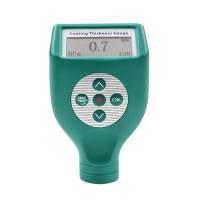
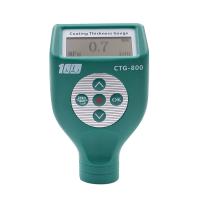
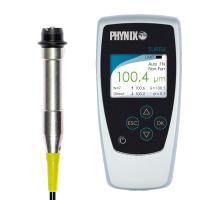
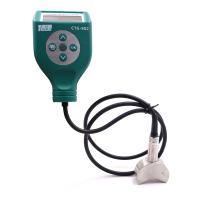
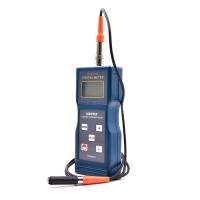
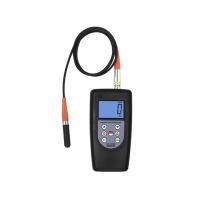
Coating thickness or dry film thickness (DFT) is an important variable that plays a role in product quality, process control and cost control. Measurement of film thickness can be achieved by selecting the appropriate flow rate for a specific application.
Why Dry Film Thickness Measurement Is Important
Dry film thickness (DFT) or coating thickness is arguably an important measurement made during the application and inspection of protective coatings. Coatings are designed to perform their intended function when used within the DFT range specified by the manufacturer. The correct thickness ensures proper product performance. Even the most basic specifications require measuring DFT.
quality measure
Regular film thickness measurements help control material costs, manage application efficiency, maintain finish quality and ensure compliance with contract specifications. Paint manufacturers recommend target ranges to achieve suitable performance, and customers expect these parameters to be met.
How Coating Thickness Gauge Works
What types of coating Thickness Gauges are available?
DeFelsko offers a wide range of coating thickness instruments and probes for a wide range of applications including for measuring coatings on metals, non-metals (wood, concrete, plastics, composites) and measuring the thickness of uncured powder coatings.
What is a Magnetic Film Thickness Gauge?
Magnetic Film Thickness Gauges are used for non-destructive measurement of the thickness of non-magnetic coatings on ferrous substrates. Most coatings on steel are measured this way. Magnetic gauges use one of two operating principles: magnetic pull or magnetic/electromagnetic induction.
Magnetic Stripper (Type 1 - Peel Coating Thickness Gauge)
Magnetic tension gauges use permanent magnets, calibrated springs and scales. The attractive force between the magnet and the electromagnetic steel pulls the two together.
Magnetic Induction and Electromagnetic Induction (Type 2 - Electronic Coating Thickness Gauge)
Magnetic induction instruments use permanent magnets as the source of the magnetic field. Hall effect generators or magnetoresistors are used to sense the magnetic flux density at the poles of a magnet. Electromagnetic induction instruments use an alternating magnetic field. A magnetic field is generated with a soft ferromagnetic bar wound with a thin wire. Another wire coil is used to detect changes in magnetic flux.
These electronic instruments measure the change in magnetic flux density at the surface of a magnetic probe close to the steel surface. The magnitude of the magnetic flux density on the probe surface is directly related to the distance from the steel substrate. By measuring the flux density, the coating thickness can be determined.
What is an Eddy Flow Film Thickness Gauge? (Type 2 - Electronic Coating Thickness Gauge)
The eddy current technique is used for non-destructive measurement of the thickness of non-conductive coatings on non-ferrous substrates. A thin wire coil conducting high frequency alternating current (above 1 MHz) is used to create an alternating magnetic field on the surface of the instrument probe. When the probe is brought close to a conductive surface, the alternating magnetic field will create eddy currents on the surface. The properties of the substrate and the distance from the probe to the substrate (coating thickness) affect the magnitude of the eddy current. The eddy currents generate their own opposing electromagnetic field, which can be induced by the field coil or an adjacent second coil.
How do you measure coating thickness on non-metals?
Ultrasonic pulse echo technology is used to measure coating thickness on non-metallic substrates (plastics, wood, concrete and composites) without damaging the coating.
Ultrasonic coating Thickness Gauges, such as the PosiTector 200, emit high-frequency sound pulses that travel through the coupling gel into the coating and reflect from any surface of varying density. Coating thickness readings are obtained by measuring the time it takes for an ultrasonic signal to travel from the probe to the coating/substrate interface and back. Dividing the travel time by two and multiplying by the speed of sound in the coating gives the thickness of the coating.