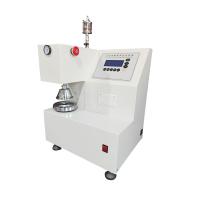
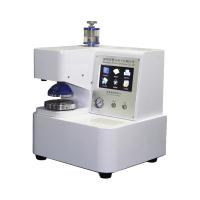
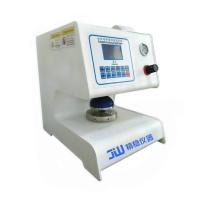
The definition of burst resistance: the maximum pressure when the elastic film breaks through the circular area of the paper pattern when the pressure is applied by the hydraulic system.
Definition of Bursting Index: Bursting strength divided by its quantification.
The working principle of the burst Tester: According to Pascal's law, the pressure applied to the closed liquid can be transmitted from the liquid to all directions according to the original size. In the sealed oil cylinder of the instrument and the cavity of the pressure paper seat, methyl silicone oil is filled as the medium for pressure transmission. When the motor drives the piston to move forward at a constant speed, the rubber film is pressurized by the silicone oil and protrudes; at this time, it is clamped on the rubber film Above, the sample fixed by the upper and lower chucks is evenly stressed until the sample breaks. The processing chip locks the maximum pressure value and displays the pressure value through the LCD screen. This pressure value is the burst resistance of the sample.
How to calibrate the burst Tester, in fact, the relevant national verification regulations, light industry standards, and national standards of GB/T1539 have clearly stipulated the calibration method - a standard pressure measuring instrument with an accuracy of not less than 0.1%. The indication error is calibrated. At present, the commonly used calibration method is to use aluminum foil to calibrate the machine regularly.

In the paper and paper packaging industry, the bursting strength is used in paper and cardboard, corrugated cardboard, etc., and the commonly used international unit is kPa. The bursting index is used in paper and cardboard, and the commonly used unit is kPa·m²/g.
Dividing the bursting strength of paper or cardboard by its quantitative is the bursting strength index.
Bursting strength refers to the maximum bursting pressure perpendicular to the surface that paper and cardboard can bear per unit area, expressed in kPa.
Standards include ISO 2758 "Paper - Determination of Bursting Strength", GB 454 "Measuring Method of Bursting Strength of Paper", SN/T 0874-2000 "Inspection Regulations for Imported and Exported Paper and Cardboard" and so on.
No less than 20 samples shall be prepared for ISO, 10 for the front and 10 for the reverse. SN/T prepares no less than 10 samples, 5 on the front and 5 on the back, and the results are averaged.